We were editing these pictures for ages, and then these girls came in and said, uh, excuse me. I think that’s our picture. And we realised we had just edited someone else’s picture. It was incredibly embarrassing, like deeply, deeply mortifying.
Hello and welcome to Easy Stories in English, the podcast that will take your English from Okay to Good and from Good to Great! I am Ariel Goodbody, your host for this show, and today I will be talking all about my Christmas holidays in Japan.

Because that’s right, I decided, hmm, Christmas! What a wonderful time of the year. What more Christmassy place could exist than Japan? I’m joking of course. Japan is not a very Christmassy place. It’s perhaps a bit more Christmassy than China, but I wanted to go there for my Christmas holidays, so I went there. And to be honest, the Christmas part was slightly irrelevant, but enough about that. You’ll hear all about that later.
First of all, let’s just address the elephant in the room. Hello, Mr. Elephant! Gosh, you have a very big trunk. No, when we say ‘the elephant in the room’, we are talking about a big topic, a big item of conversation that everyone is thinking about, but nobody is saying. And the elephant in the room, with a very nice trunk, is: it’s 2026! Happy New Year! Woo!
I mean, as you are listening to this, it’s probably been 2026 for a while, but as I record this, it is New Year’s Day. Mm! The New Year smells fresh and sweet and delicious, because it has only been 2026 in China for about 13 hours. And perhaps… No. That means it’s been… No. How do time zones work? Maybe in some parts of the world it still isn’t 2026. I didn’t go to school to become a mathematician or a chronologist, so let’s stop thinking about that.
But anyway! When it comes to New Years, to the turning of the year, the passing of one number to another number, that is one number higher, because years go up one by one. See, maybe I could be a mathematician and a chronologist! When it comes to these things, there’s another elephant in the room, kind of maybe like a smaller elephant sitting on top of that other elephant. Hello, baby elephant! Gosh, your trunk is so small and adorable.
And this elephant is New Year’s resolutions. That’s right. The new year is a wonderful time, a chance, an opportunity to make some changes in your life, to make plans, decisions, visions, to say, this year I will do X, Y, Z! Or this year I will stop doing A, B, C.
Now it’s become kind of trendy in recent years to pooh-pooh New Year’s resolutions, to say, New Year’s resolutions? No, thank you. I don’t want to make New Year’s resolutions. People have all kinds of arguments like, oh, they’re not, they don’t really work. You’ll just give up on them in a month. It’s trying to be like too productive, too project focussed. It doesn’t really align with the natural seasons of our bodies.
And to that, I say two things. First of all, the baby elephant sitting on the other elephant, the bigger elephant, the baby elephant is now crying because you don’t like New Year’s resolutions. You’ve made him cry. Are you happy? Have you ever heard an elephant cry? Oh, it is one of the most heartbreaking sounds in the world!
And number two, I love New Year’s resolutions. I think New Year’s resolutions are great, and even if your resolutions aren’t successful, even if you do give them up, merely the fact that you committed to a plan, you made that plan in the first place, you did something, and you were trying to change yourself, to self-actualise, to build upon the project of yourself, that is wonderful and worth celebrating.
So on that note, I should tell you my New Year’s resolutions for 2026. Hmm. Shouldn’t I? Hmm. Hmm. Well, I shan’t! Aha. I will not tell you because I believe that when we are starting new projects, it’s really, really important to not talk about them too much. If you are always saying, I want to do this, I plan on doing this, I’m going to do this, then the likelihood is you are going to do nothing of the sort. You are not going to do those things because you’re talking out all of that energy that you could be holding inside and using to drive you towards actually doing that thing. There’s also a fun in it, like if I start this project but I don’t tell anyone about it, then I can only tell people after I’ve been doing it for a while, and that in itself is a great motivator.
All that is to say, I’m not telling you my New Year’s resolutions yet. If I do tell you about them, it will mean that they were successful and you shall hear about them, I believe, in a few months’ time. Hmm. It really depends how things go. Obviously, I would love your support in these unnamed projects, so if you could just leave a comment saying, you can do it, Ariel! I believe in you! I don’t want that elephant to cry. I want that elephant to be so happy. Please do that. And then I might achieve my New Year’s resolutions.
So anyway, onto my holiday. I spent a week in Japan from the 20th of December. My God, I almost forgot the month! To the 27th of December. And I flew out from Shanghai Airport, which meant I had to travel from my city Ningbo and spend a night on either end. So I stayed in a hotel in Shanghai at the beginning and the end of the holiday.
So I finished work on Friday and I rushed home to grab my suitcase, get changed, and head straight to the train station. It was a pretty tight window because I finished work at about twenty to five, and the train was about ten past six, and the problem is, it was rush hour, so I couldn’t just get a taxi to the train because then I might get caught in traffic. So instead I got the metro. But of course, running for the metro, carrying a heavy suitcase, well, it’s not really possible. You can powerwalk, but you can’t really run.
So I was already starting things off with a bit of a manic stressful movement, but it was all fine. I got on my train to Shanghai and I was really hungry on the train because I didn’t have time to pick up dinner, and they sell food on the train, but of course it’s a lot more expensive. I asked for some crisps, these kind of like crisps from Sichuan, so they’re very spicy, that I’ve had before and they have cute little hedgehogs on the packet, but the women selling food, the, the, the food trolley woman said, don’t you want these? They’re fresh. Which is a very Chinese thing, like it’s a very different approach to customer service. Like you say what you want and they say, no, you don’t want that, you want this. And I was like, okay, cool.
So I bought a box of something that had duck in the name. And I opened it to discover it was ducks’ necks, a collection of delicious ducks’ necks. And ducks’ necks are quite bony and incredibly spicy because it’s Sichuan-style duck neck. So I sat there on the train eating my duck necks, um, and of course, because of all the spiciness, my eyes were watering and my nose was running and I had to finish them very quickly so I could go and blow my nose and wipe the tears away.
And this just really goes to show how much my tastes have changed since coming to China. Previously, I would never eat something that spicy, and generally my spice tolerance has improved massively. There’s so much food I eat here now that it’s only halfway through eating it I realise, oh, this is actually spicy, but it’s a level of spiciness that just doesn’t register to me anymore, whereas back in the UK I would’ve immediately noticed the spiciness.
Now, I wish I could say my journey from Shanghai Hongqiao train station to my hotel near Shanghai Pudong Airport was as smooth, but it simply was not, and it didn’t even involve any duck’s neck.
First of all, there are three ways to get from this big train station to this big airport. One of them is to take Metro Line two, which goes directly and is the, I guess, the oldest way of getting there, but that takes like two hours. Another way is to get line two into the centre and then get the Maglev train, which goes very, very fast. It takes like 20 minutes from the city centre. The third way is to use the newly-constructed metro line, which goes directly from Hongqiao to Pudong with very few stops between and takes about 50 minutes.
Now despite constructing this wonderful new metro line that halves the time it takes to get between these transport hubs, it is not well signposted. It is simply not clear when you get to the station where you need to go to get on this line. So I accidentally ended up getting on the number two metro line because I could not see any signs for this new line. They simply were not advertising it. They even had signs next to the ticket machine saying, do you want to go to Pudong Airport? Get Metro Line two. So that’s what I did.
So it took me like two hours to get there, and then it was like 10:00 PM and I tried to get a taxi, but they have huge taxi ranks at Pudong Airport and I told the taxi driver I was on the wrong floor by accident. So I was like running around for like 10 minutes trying to find this guy. It was very stressful. But finally I got my taxi and he drove me to my hotel, which, you know, 15 minutes drive from the airport doesn’t sound too bad, right? Like you would think it was a built-up area. Um, I felt like I was going into like an army base or something because it was dark, so I couldn’t see anything, the roads were pretty rough, there was like construction going on everywhere around. And finally we arrived to the hotel.
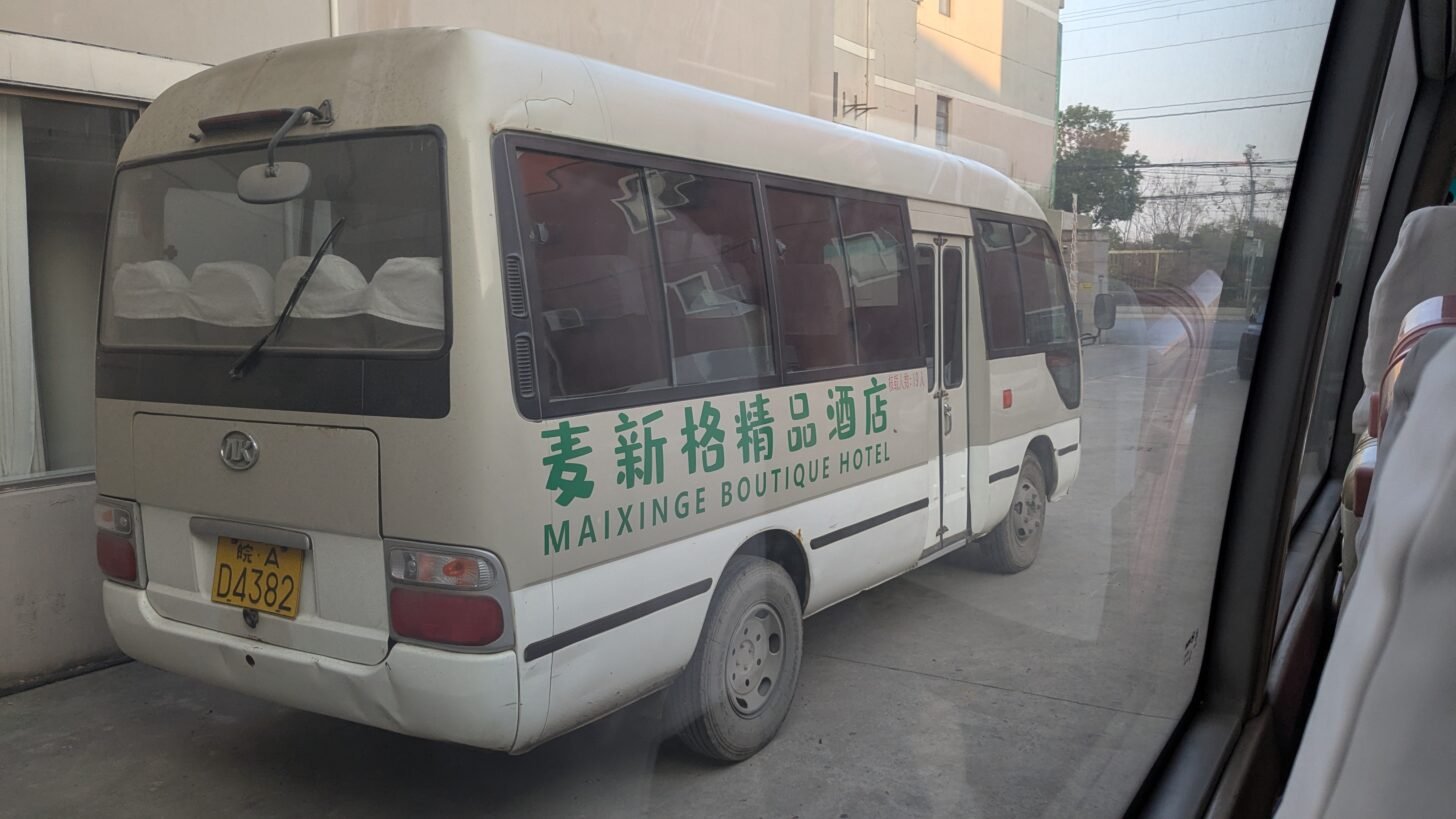
Which, um, had ‘boutique’ in the name, but I feel like boutique was rather aspirational for this hotel. Pretty much this hotel lied, this hotel scammed and cheated me because when you compared the pictures on Trip.com where I booked it to the actual building, it was clear a lot of Photoshopping had gone on, and I didn’t realise quite the extent to which this was until the next morning when I woke up and could see everything in the morning light. There were massive cracks in the side of the building, there was a lot of rubbish outside the back of the hotel. The ‘shuttle bus’ that took us to the airport was a beat-up old minivan, and we all had our suitcases just on the floor between our seats.
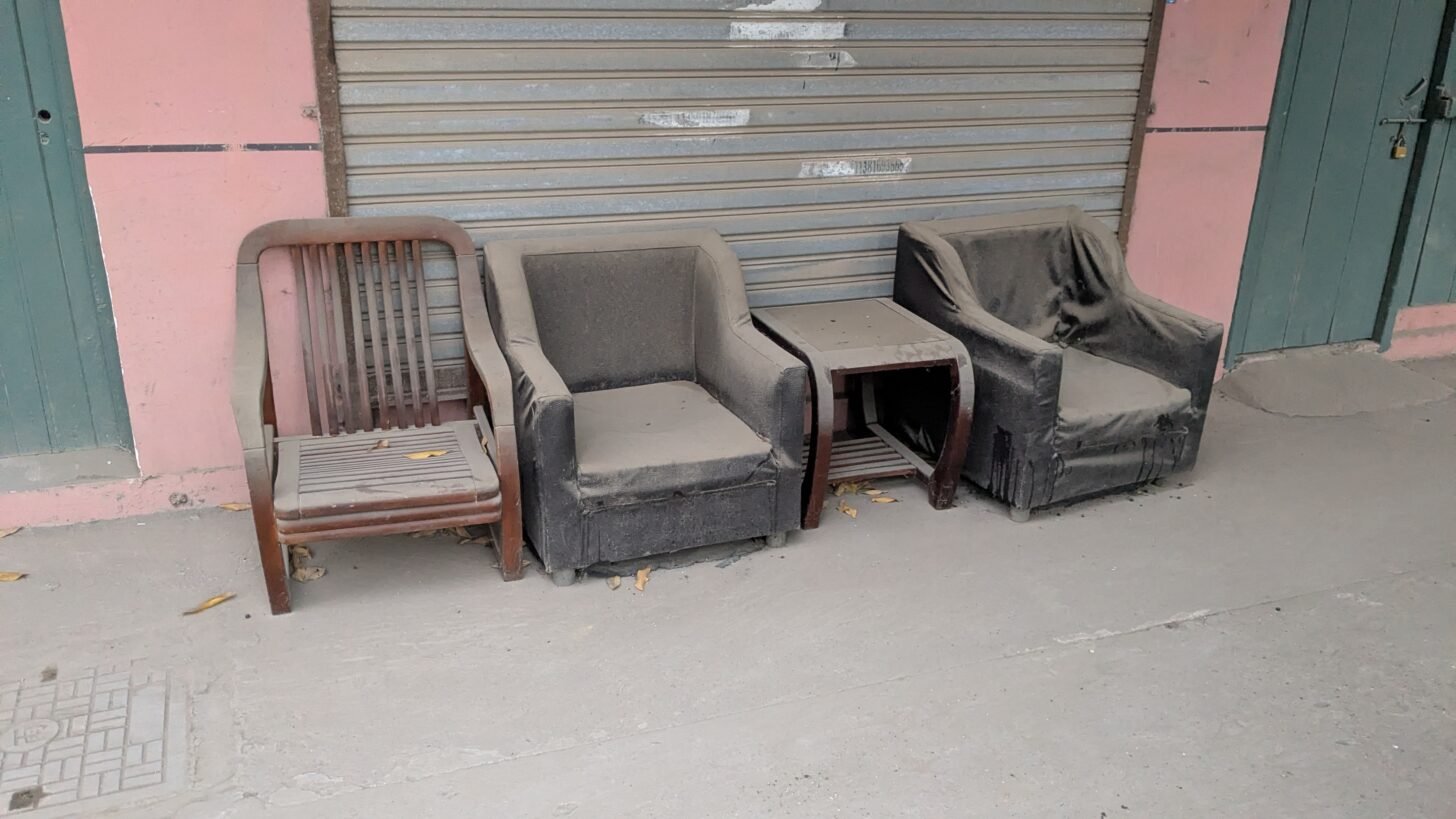
The whole thing was not giving luxury or boutique in the slightest, but it was incredibly cheap. Uh, it was 15 pounds for one night, um, which I don’t know is maybe like 22 dollars. It was incredibly cheap, but it really was in a very strange place. It felt like a village in the middle of nowhere that suddenly had an airport built really close to it. So it had like a few places that were open for breakfast, and obviously it had this hotel, but for the most part it was really rural and dirty. And there were some places where the roads just turned to dirt roads ’cause I wandered around a bit. ’Cause I wanted to see what it was like. So, um, I can’t say I’ll be going to that hotel again.
Fortunately, my flight was very easy. I went with Spring Airlines, which is a budget Chinese airline, and when I compare it to European budget airlines like Ryanair and EasyJet, it’s great. You have lots of leg room, you don’t have to wait in a freezing cold corridor before getting on the plane. But in other ways, it felt incredibly old fashioned. Um, Spring Airlines does not do online check-in. You have to check in at the airport, which seemed a bit strange to me, but there we go.
Also, they spend about 40 minutes on the flight flogging perfume and jewelry. They have someone stand at the front talking about all these amazing products you can buy, and then other flight attendants going up and down the aisles with a big iPad trying to sell you things. And I mean, they do this on most cheap flights now, but it was so long, like it, it was a two hour flight and it was a good chunk of those two hours. So, didn’t love that.
I landed at Nagoya Airport. The reason I flew to Nagoya was I was going to Takayama, which is a small town in the mountains, and Nagoya is the nearest airport. So I arrived at Nagoya, I went and bought this specific ticket that’s like a combined train and bus ticket to Takayama. So you get the train from Nagoya Airport to Gifu, and then you get the bus from Gifu to Takayama.
And already I was feeling just some lovely little like touches and details that really make Japan Japan. Japan has such a beautiful dedication to customer service and providing care and really paying lots of attention to detail. So when I bought this combined bus and train ticket, it came with this voucher for discounted, uh, tourist tickets to Gifu. So if I wanted to, I could exchange this voucher at this other counter and get cheap, like museum tickets in Gifu. Now, I wasn’t spending any serious amount of time in Gifu, so it wasn’t worth it, but the fact that they promote it in that way is just so lovely to me. It almost made me wonder, should I change my hotel dates and stay in Gifu? You know?
And then when I arrived at Gifu Station and I needed to change to the bus, I showed one of the people in the train station my ticket, and he explained the whole system. He gave me a little map that showed like where you leave the train station and where you go for the bus stop. And keep in mind, the bus stop was like a three-minute walk from the train station. It wasn’t difficult to find. You just crossed the street and walked down. But the fact that they give you this little paper map and they explain exactly where you need to go is just so lovely to me.
And that’s what I love so much about Japan is, there’s just so much care in the small things, and okay, I speak fluent Japanese, but I think these small details really make Japan very accessible for tourism. It’s a place where really, if you are lost or you need help, there’s always someone you can ask, and the details given, I don’t know, it just was a huge contrast between Shanghai where I literally could not find this train that would have made my journey one hour shorter because they didn’t bother putting up new signs yet, and then coming to this small town and being told like exactly where I need to go to catch a bus. It was very cute.
Now, did I go wandering in Gifu before my bus? Yes, I did. Because I had some time before my bus. Did I get a bit lost and almost miss my bus? Yes, I did. But I caught the bus in the end and that’s all that matters.
One area where Japan is very different from China is the expectations and norms around public behavior. So in Japan, if you’re on a train, if you’re on a bus, usually it’s not acceptable to eat food or to drink, let’s say, hot drinks or to talk on your phone or play music. Um, in China, you can tell they’re trying to change these things, like you see announcements and adverts in the subway saying like, don’t be rude, like, don’t talk really loudly on the phone, don’t eat food. To be fair, I’ve not seen people eat food on the metro in Ningbo, but people are very loud, whereas in Japan, when you’re on the train or the bus, everyone really keeps their belongings to themselves. They don’t take up too much space. Everyone is very considerate.
So travelling long distances by train or bus in Japan is really very pleasant because, um, people are well-behaved, I guess. And this is something that frustrates me in the UK as well, especially in London. So often I got on a bus and would be like, okay, let me read my book, and then some people would be shouting behind me or whatever. There was always some kind of noise disturbance, whereas in Japan, people are really, really very considerate about that.
Of course, it can feel frustrating at times, like maybe you want to make a phone call on the train, or you want to eat some snacks, but you’re not sure if it’s appropriate. These rules are a bit vague, like sometimes on the train, oh, if I’m sitting near people, maybe I shouldn’t eat, but if I have a seat by myself next to the window, maybe it’s okay. So it’s not always clear if you should be following the rule, and if you break the rules in Japan, people don’t usually say it to your face, but if you do discover you’ve broken a rule, it can feel really embarrassing, uh, as I discovered later on in my holiday. We’ll get to that later.
So anyway, I finally, finally arrived in Takayama and I got another shuttle bus to my hotel. Now, I just booked one of the first suggestions that came up for hotels in Takayama. I wasn’t originally going to stay in Takayama, but it’s the closest real town to Shirakawagō, which is a beautiful historic village that I wanted to visit. I did a podcast episode, A Holiday Gone Wrong, which was set in Shirakawagō.
It had taken me a 12-hour flight and a four-hour bus journey, but I was finally here. Shirakawagō. A traditional Japanese village hidden among the mountains in the centre of Japan. It had peaceful rice fields, thick mountain forests and charming traditional houses.
But I wasn’t here to get away from the fast pace of Tokyo. No, I was here because of murder, madness and ancient curses.
I could have stayed in Shirakawagō in one of these beautiful, historic guest houses, but they are incredibly expensive and I just thought, you know, maybe if I go back, maybe if it was a nicer time of the year, warmer weather, but the middle of winter when it’s rainy is maybe not the time to be staying in a wooden thatched house.
So instead, I opted to stay in this hotel in Takayama, and I accidentally booked like a really gorgeous resort. Basically, it was a fabulous resort hotel with three restaurants. It had onsen, like hot springs, on the fifth and seventh floors, so you could sit in the hot springs and look out over the surrounding mountains. They gave you yukata, like traditional Japanese kind of, um, bathrobes or pyjamas I guess. So you could wear your yukata to go to the onsen. It was built maybe in like the sixties or seventies. It had like a very vintage aesthetic, but it was clearly also renovated at some point. So it was very comfortable. It was well heated. It was beautiful.
Again, there was that real attention to detail, like when you pressed the buttons for the lift, the buttons just had a really satisfying feel to them. All of the service was really friendly.
So the first night I arrived there, I tried one of the restaurants. I had some Hida beef. Hida beef is the local specialty. It’s like a special kind of beef. And I tried some of their local sake, which they make for the hotel specifically, and it was very yummy. And then of course I had to try the onsen, the hot springs.
Because despite being fluent in Japanese and having visited Japan multiple times, I still had never gone to an onsen. It’s one of those things where it’s very different from my culture because you’re bathing naked, uh, with a bunch of people in a public space, which is not something I was comfortable with in the past. Now it’s something I’m very comfortable with.
So to get to the hot springs, you walked through this special part of the hotel. You had to take your slippers off. There was this corridor of traditional Japanese architecture, so tatami mats, like I don’t even know how to translate tatami. If you don’t know what tatami is, just Google it. And then you got to the changing rooms, and then you could go into the onsen.
Now, there are very specific rules with onsen. You have to shower and wash your entire body before you get into the water because obviously you’re sharing the water with people. But I think there’s also like a ritualistic element to purifying your body before you get into the water. It certainly makes it both a more hygienic and relaxing experience.
Now, I kind of messed up because the first time I went I didn’t bring my glasses and I left the changing rooms and I should have gone straight forward to the showers, but I missed the showers and accidentally went straight to the onsen. And then I was like, where are the showers? So I kind of washed myself in one of the pools that seemed like a little bathtub, but um, I should have showered fully before going in. Oops! And then when I left, I discovered the showers. But every other time I went to the onset, I did shower myself. So, you know, lesson learned.
Another rule that many onsen, including this one have is: no tattoos. And this is because tattoos in Japan are associated with the Yakuza, which is their Mafia. So it’s considered disrespectful to show tattoos. Now I only have one tattoo. It’s on my left forearm. So actually, if you haven’t seen it, it’s a slug! Um. That’s like a snail without a house on its back. It’s a snail that’s renting instead of buying.
Anyway, I only have one tattoo, so I thought I could cover it up. I used these, uh, they’re like white cloth sleeves that you put on your arm in the summer in China, and it somehow cools you down. I don’t really understand the technology, but I used one of them to cover my tattoo and it was fine. No comments. Nobody looked at me weirdly. If someone did ask, I would’ve just said, oh, I’m covering up a scar, which like, technically isn’t that wrong ’cause a tattoo is kind of like a scar. They even sell these special like stickers that kind of cover up your tattoo and just look like skin. So, uh, I’m not the only one doing this kind of thing, but I was a bit worried about it, of course.
So the onsen experience was lovely. Obviously the views were amazing. The water was less hot than I expected, I think maybe because I’m more used to saunas where it’s like a, woah, like a really intense experience. But the onsen experience is very relaxing and there’s a very pleasant contrast between the cold winter air and the warm water. It just felt very relaxing, very soothing. I definitely slept really well while I was there.
Also in the changing room of this resort, they had like these lovely haircare products, they had combs, they had hair dryers, and they had lovely foot massagers. So I also got a foot massage every day I was there. It was great.
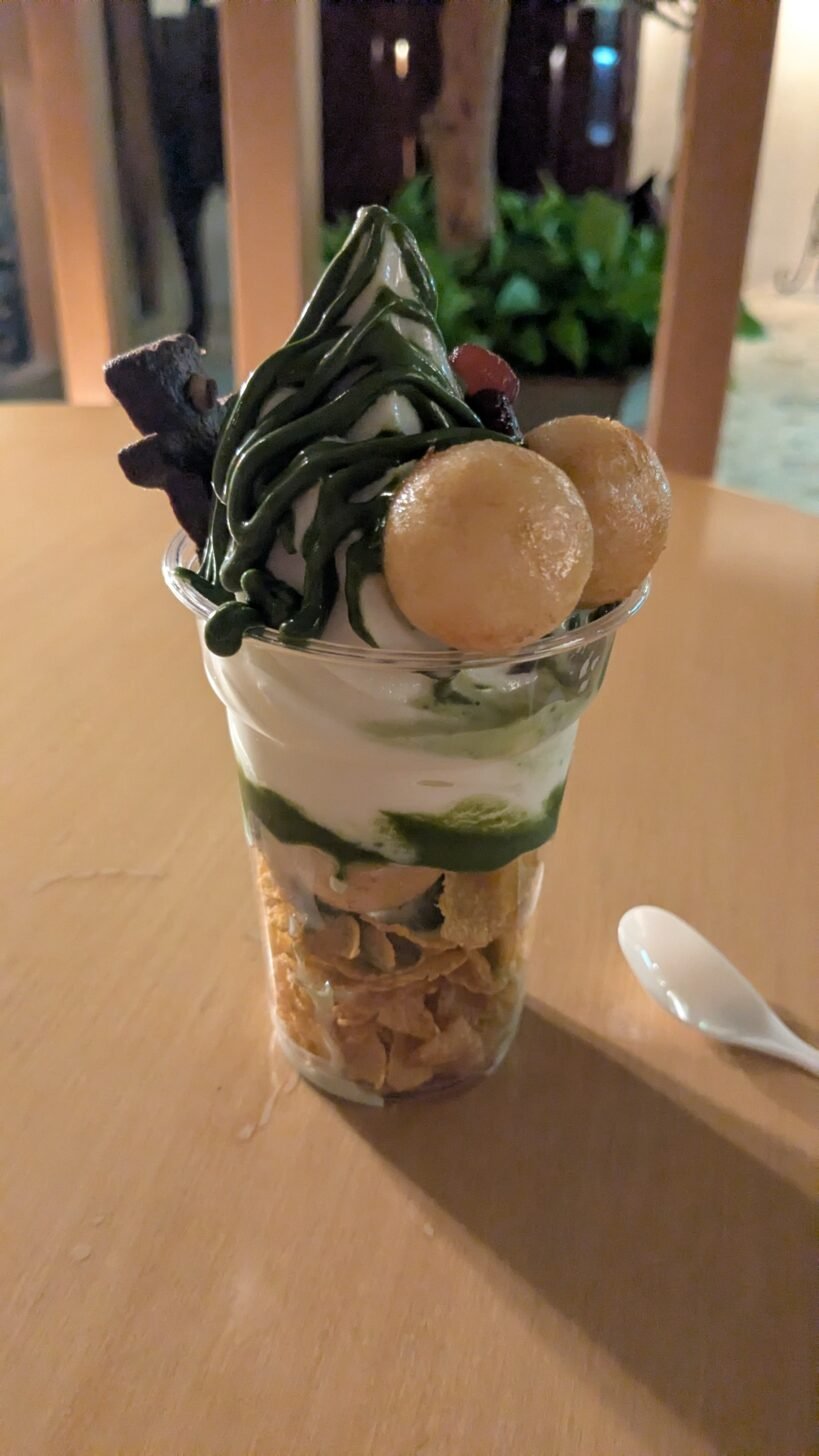
And then after the onsen, that first night, I went and got some ice cream made with milk from the local Hida cows. So it was just a good day all around.
So the next morning I got up bright and early to go to Shirakawagō, the UNESCO World Heritage Site, this beautifully preserved Japanese village with traditional wooden thatched houses. And the reason I got up so early was because one, I had to get a shuttle bus from the hotel into Takayama and then a bus from Takayama to Shirakawagō. So there was just the timing issue. And then also the weather forecast was not so good. It was forecasted to rain later in the day. So I thought I better go as early as possible.
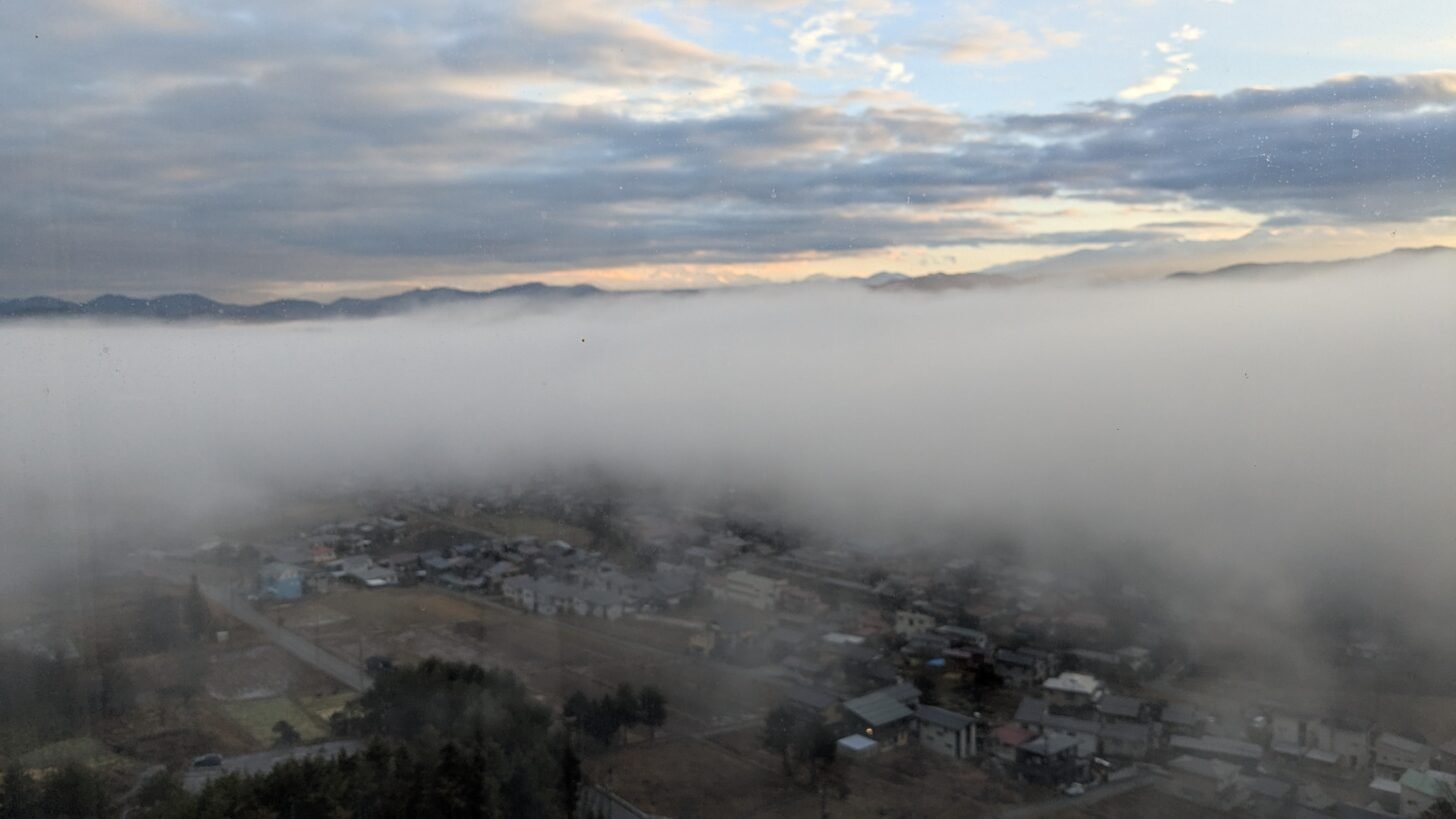
But before I left, I got to watch the mists from my bedroom window, the mists parting over the mountains, the mists swirling around the hills, and it was so gorgeous. Like it was just one of those beautiful moments of the majesty of nature that really just made me feel, oh, oh my God, I love it.
Now, the bus to Shirakawagō I thought would be beautiful and scenic, but actually it was just a lot of tunnels, and that kind of makes sense, right? Because we were in an extremely mountainous region, so the only way to conveniently build roads there is to make a lot of tunnels. But the bus driver gave us some lovely commentary. He told us that one of the tunnels was the third longest tunnel in Japan. He told us where the good photo spots were, and he informed us that before this one particularly long tunnel was built, it would have taken two hours to get there instead of one hour. So that just goes to show the power of tunnels, I guess!
Anyway, I got there. It was lovely. I’m glad I went early because it got much busier as the day went on. Shirakawagō is really just one of those truly magical places, and I think it’s a good thing that it’s so difficult to get there. The fact that it’s so isolated really gives you a feeling of being in a different world. You’re high up in the mountains, you’re in this very rural area. In some ways, it’s really like stepping into the past.
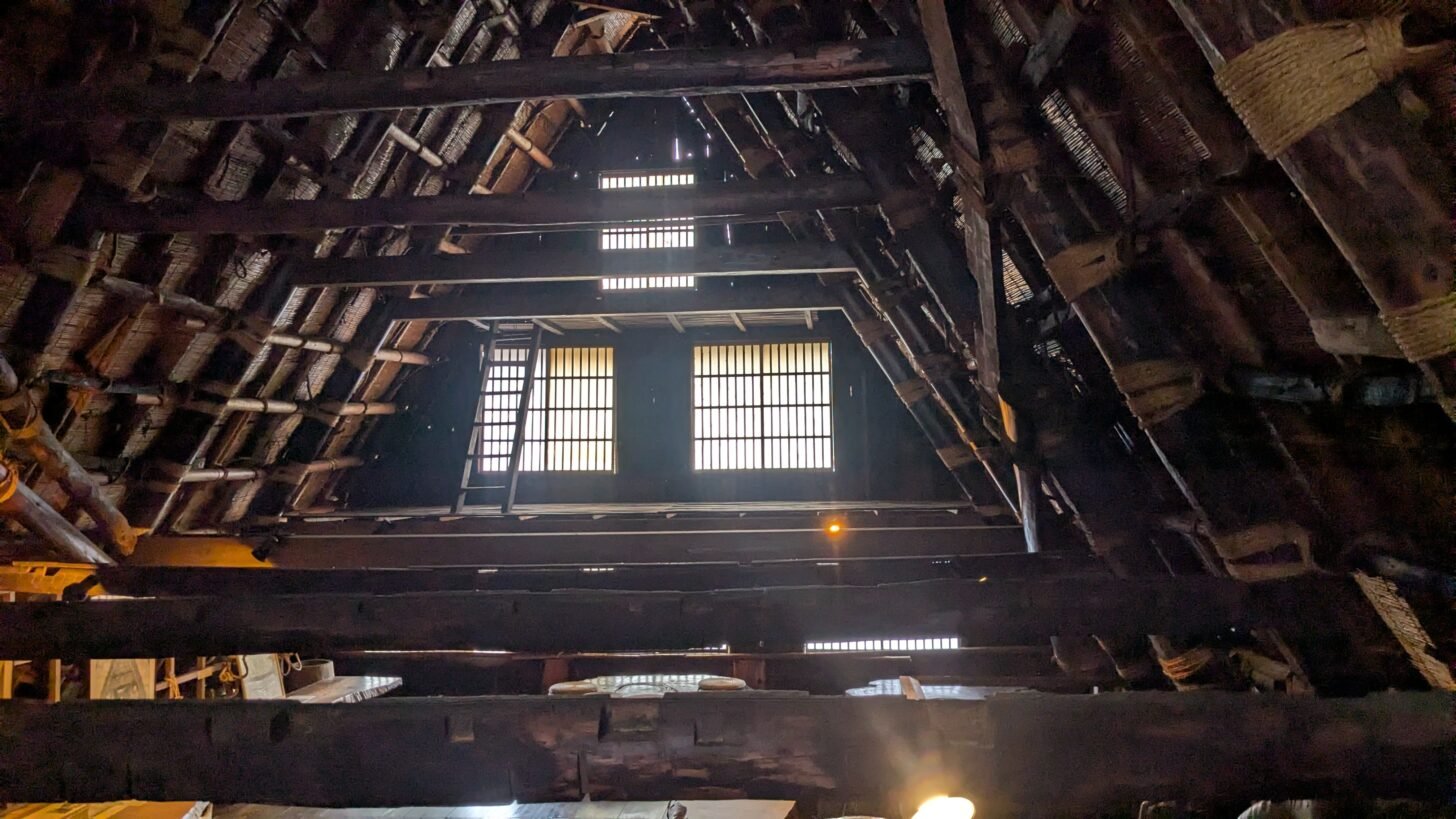
Now, I said all of these houses were traditional wooden thatched houses. So a thatched house is a house with a roof made from dried plants, essentially. We also have a tradition of thatched roofs in the UK. In Japan, these are called gasshō-zukuri, and they use, I believe, uh, reeds? They use some kind of Japanese plant that I can’t remember the name. But basically, every year they have to rethatch the roofs. They have to remake the roofs because they get, you know, wet and damaged by the snow and the wind and the rain. And this is an area where it snows a lot in winter. So every year the villagers all get together and rethatch the roofs using these traditional techniques.
You can have a great time in Shirakawagō just wandering around and looking at the buildings. But there are also amazing gift shops with loads of local crafts, there are museums and lovely, lovely restaurants and cafés.
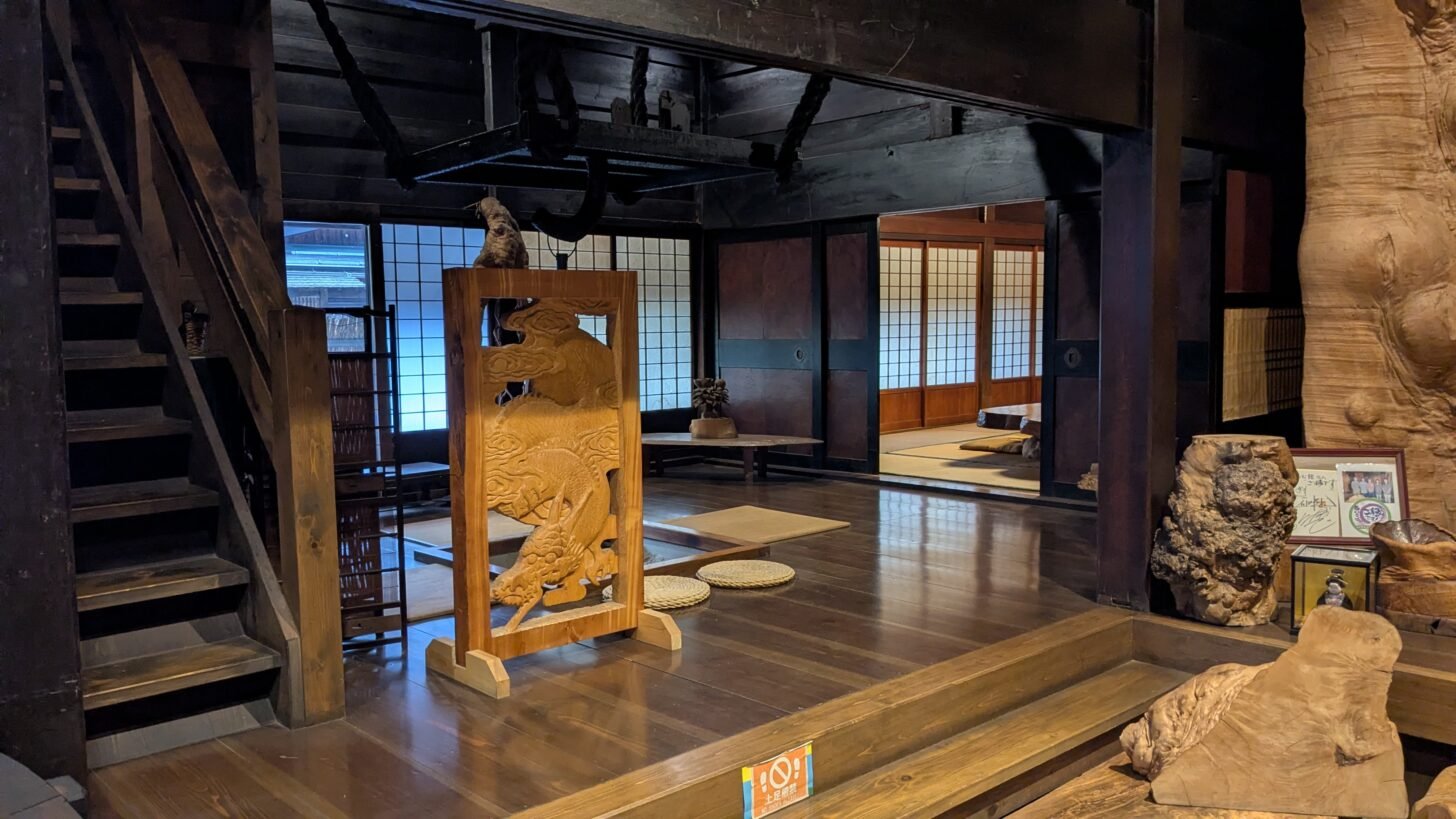
So I went to this woodworking art gallery where someone had made all of these amazing, uh, sculptures out of wood, and it was just so gorgeous because alongside seeing the sculptures, you got to explore the inside of this thatched building and climb up all the different levels, see all the furniture. Even though it was cold and cloudy and a bit rainy, it was just so gorgeous, so peaceful. And I learned from a little exhibition about the traditional techniques they used to make and maintain these roofs.
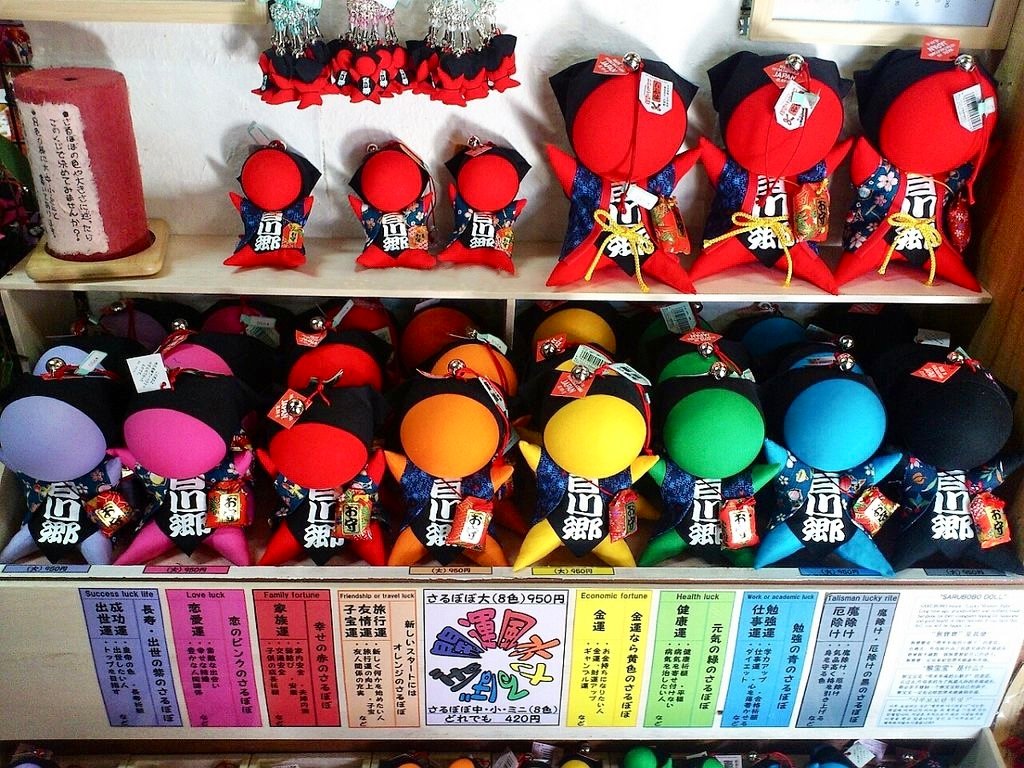
One of the traditional crafts is Sarubobo, which are these little dolls that kind of look a bit like pin cushions. You know those round things you use to put pins in when you are sewing? And they’re like, yeah, these little dolls that are wearing clothes and they come in different colours and you give them as gifts and each colour represents a different thing. So if you give someone a pink one, you’re wishing them love, if you give them a red one, you’re wishing them a good marriage or happy family. I believe a yellow one was good luck with gambling and a black one is protection from evil. So I bought some of these Sarubobo as gifts. Oh, Sarubobo literally means ‘monkey baby’, which I just think is very cute, though they don’t really look like monkeys, but anyway. I think there’s also a tradition of grandmothers passing down a Sarubobo they made to their granddaughter or their grandchildren, something like that.
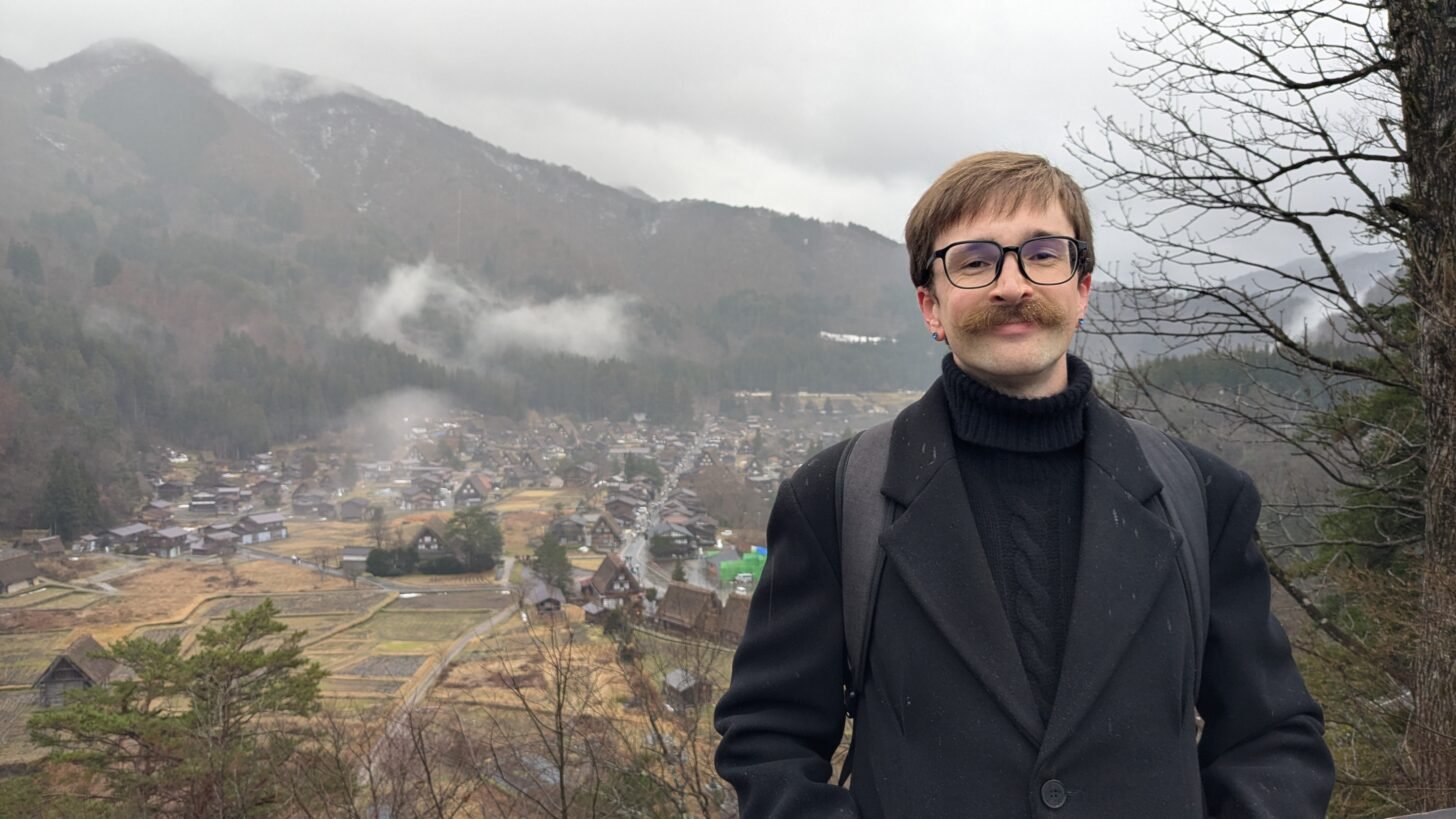
I also wandered around the pine forests, the local shrine, I had some yummy, yummy, yummy matcha cake in a little café. I had a gorgeous soba dish with lots of local vegetables in a restaurant, and I went to the observation point high up where you get an amazing view of the village. This was kind of the pilgrimage site for me, I guess, because I originally heard about the village because I really liked this Japanese animated series Higurashi no naku koro ni, which is set in like a replica of this village. The village in that series is extremely close to this place. It uses this place as its inspiration. So when you go to this observation point, it’s like you are looking at part of this show, and that was really, really cool.
At that point, it was raining quite heavily, so it was around 3:00 PM and I left to go back to Takayama feeling very fulfilled. That evening, I had a gorgeous, super fancy sushi dinner at one of the hotel restaurants, and I just kind of people-watched. I used to solo travel a lot, but when I would solo travel, I would be going out and doing loads of stuff. I never really went to resorts and it was never really my thing, but it was so gorgeous just to eat a lovely meal, look at the other people, listen into conversations, go to the onset afterwards. It was really nice.
It was an interesting time to be visiting Japan from China because there was recently a political kerfuffle. The Japanese Prime Minister made some comments that the Chinese government did not like. The Chinese government cancelled a lot of flights to Japan. They canceled a lot of events like concerts of Japanese artists in China. And Chinese tourism had been a big, uh, driving force in a lot of local economies in Japan. So a lot of these places, I guess, were a bit worried because there were fewer Chinese tourists coming. Many Chinese and Japanese people I talked to around this time said, oh wait, can you go to Japan? Like, they assumed all the flights had been canceled.
So, it was a bit strange. There were very, very few Chinese tourists. There were a lot of tourists from Korea, Taiwan, Hong Kong, uh, quite a few Filipinos as well, I think, but very few European tourists as well. I think if I had gone to like Tokyo, I probably would’ve seen a lot more foreigners, but, um, there was also a lot of Japanese tourists there, and also it was off season.
And then finally on my last day in Takayama, I took a lovely morning bath in the onsen, I watched the sunrise from the hot waters, and, you know, after all that worrying about my tattoo, I was quite shocked when I was in the changing room getting my foot massage to see a Japanese man walk in from the onsen going ‘Ah!’ with massive tattoos all over his chest.
So maybe he thought it was okay because it was early morning and there weren’t many people around. Maybe he didn’t care about the rules. Maybe he was a member of the Yakuza. But either way I was like, oh, okay. Japanese people break that rule sometimes as well, I guess. So there we go.
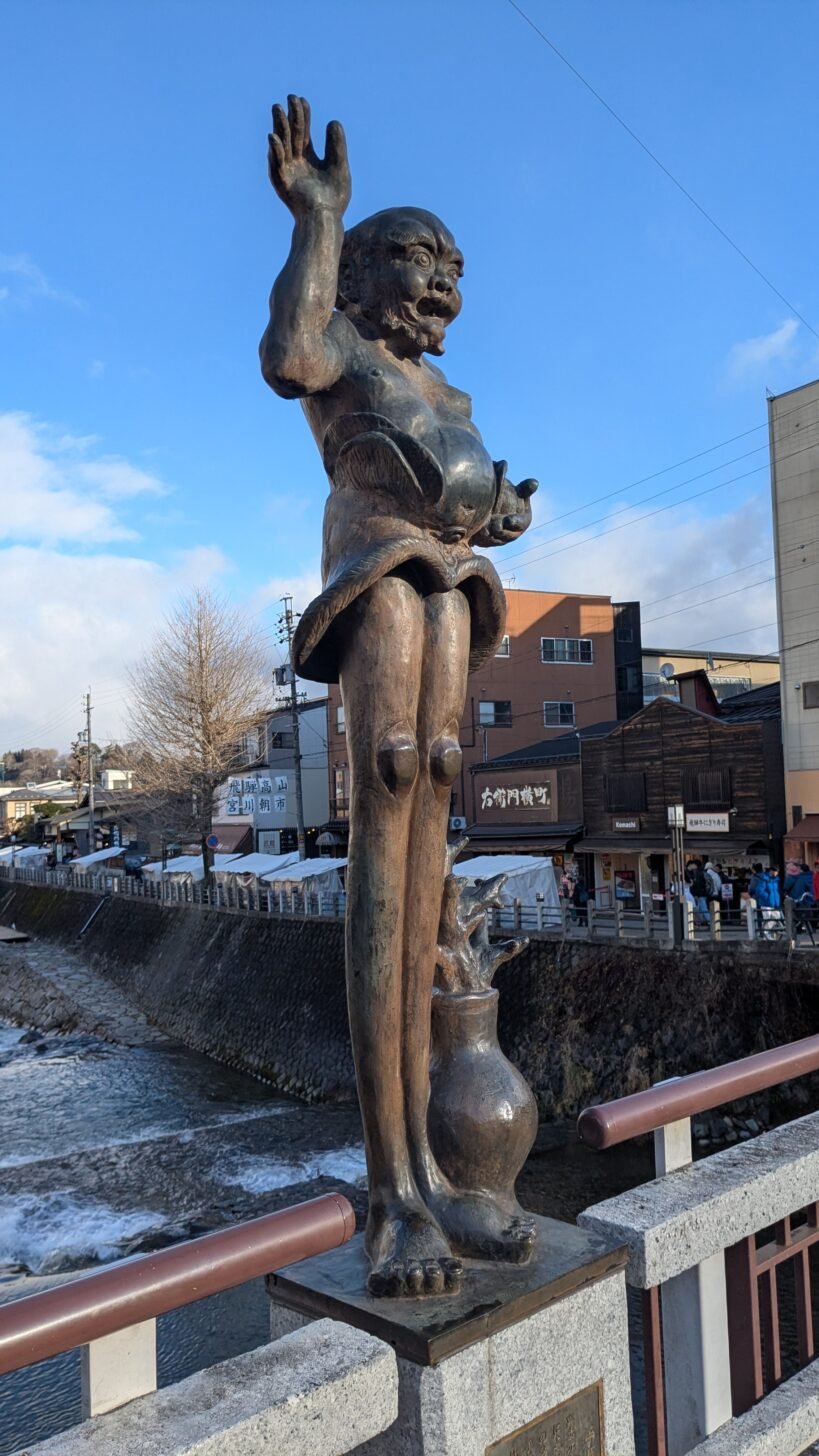
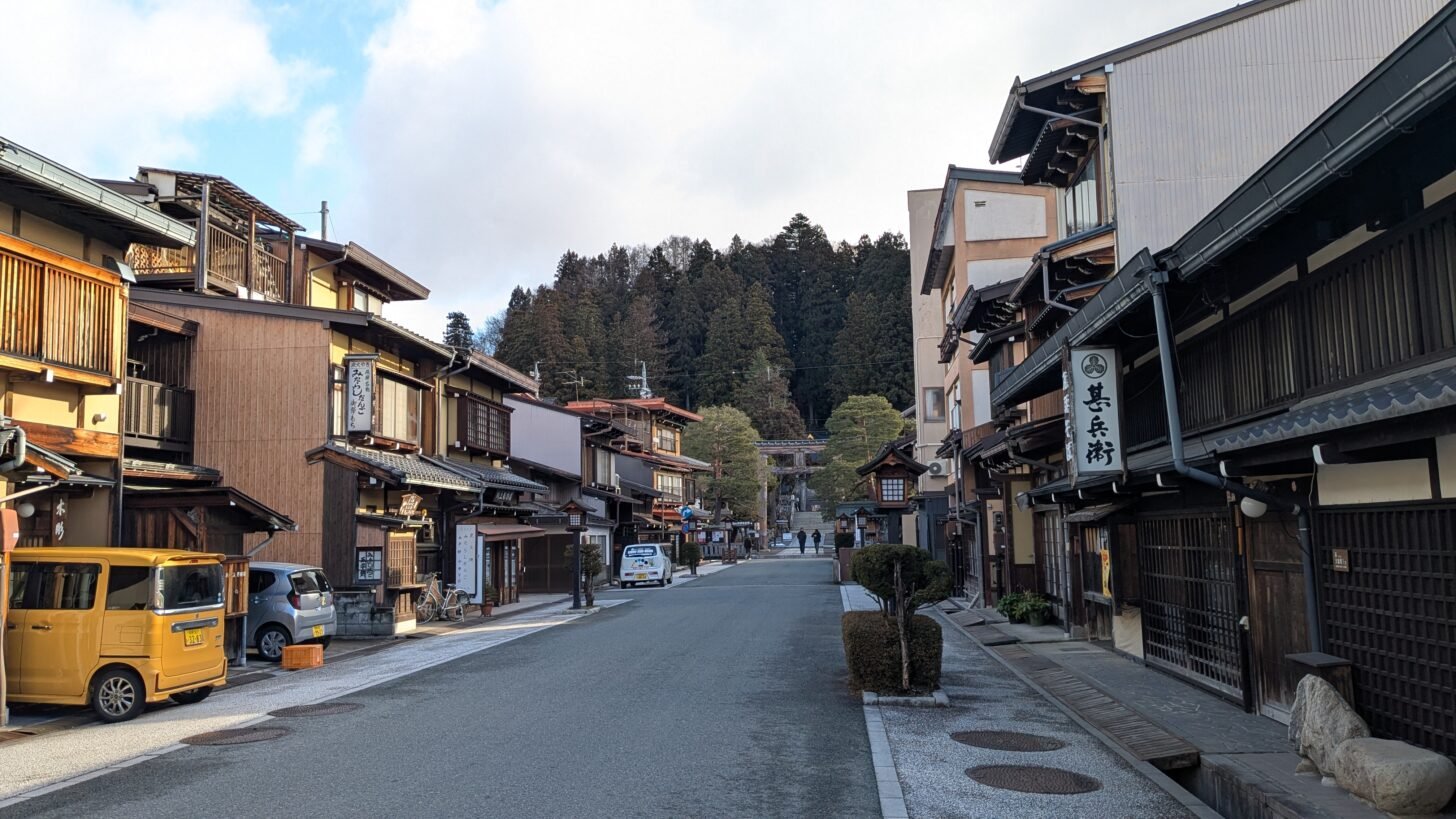
I checked out of the hotel, I went into Takayama Central, I stored my luggage and I wandered around the city, and it’s a lovely, lovely town. It’s really beautiful, very historic. It has some gorgeous old-style houses. I visited this cute little morning market, I visited a shrine and I even walked into some of the kind of hills just outside the town and chatted to some of the locals.
A great conversation starter in this kind of place is, funnily enough, bears. So in rural Japan, bears are quite a problem because more and more people have been moving to cities. The populations of bears have grown in rural areas, and it’s not uncommon to hear stories of bear sightings in these rural towns, people seeing bears, and sometimes even being attacked by bears. Actually, in some areas, they even encourage people to shoot bears if they see them because they can cause destruction and kill people.
So one of the things you’re supposed to do if you are walking in the countryside in many areas is carry a bear bell. So it’s basically just a bell that you put on some part of your body, and as you walk, it makes a sound that will scare any bears away. So I actually started a conversation with someone because she had these keys or something on a chain that were jangling, and I asked if it was a bear bell. So there you go.
So at around midday, I got on the train and I headed to Osaka for the second part of my trip. Osaka is one of the big cities in Japan, and I basically decided to stop there because I was headed towards Fukuoka, which is in the south, and Osaka was a nice stop between, because I had to get a two-hour train from Takayama to Nagoya and then get a train from Nagoya to Osaka. So it was good to just stop for a few days before moving on to Fukuoka.
And Osaka is a city I hadn’t really properly experienced. First of all, let’s talk about the journey because, oh my God, that two-hour train journey from Takayama to Nagoya was just non-stop gorgeous scenery. There were multiple points where I just looked out the window and went, wow, because it was all beautiful forested mountains, mountain rivers, small mountain towns.
It was just gorgeous, and I found myself falling asleep very happily at one point. There’s something about the combination of the quietness of Japan and being in these rural landscapes that really just made me feel very restful, and I had many lovely naps in Japan, including on that train journey.
Once in Nagoya, I changed to the Shinkansen, the bullet train, which is Japan’s high-speed rail network. It’s very interesting to compare the Shinkansen to China’s bullet train system because Japan’s system used to be kind of top of the line, the best in the world, the smoothest, fastest, cleanest experience for bullet trains. But China’s system is now far wider than Japan’s, and I think the speed and technology of the trains is probably better in many instances. Also, China’s bullet trains are way cheaper than in Japan.
However, again, there’s just like a, an attention to detail in Japan’s trains and stations, and also a level of customer service that I find really comforting and refreshing. Obviously, it’s helped by the fact that I speak Japanese. I like using paper tickets. You know, in China you just bring your passport as your train ticket, essentially, but I just like having train tickets. I like not having to do a big security check every time I get on a train. That’s also nice.
And there’s just lots of small details, like in Japan, every train line has a different noise that plays when you get near to a stop, or it might be each stop has a different noise. They’re these kind of like melodies, basically. There’s just all these lovely little details that make it feel really comforting. I’m also aware that I’m biassed because I have lots of nostalgia around travelling on trains in Japan.
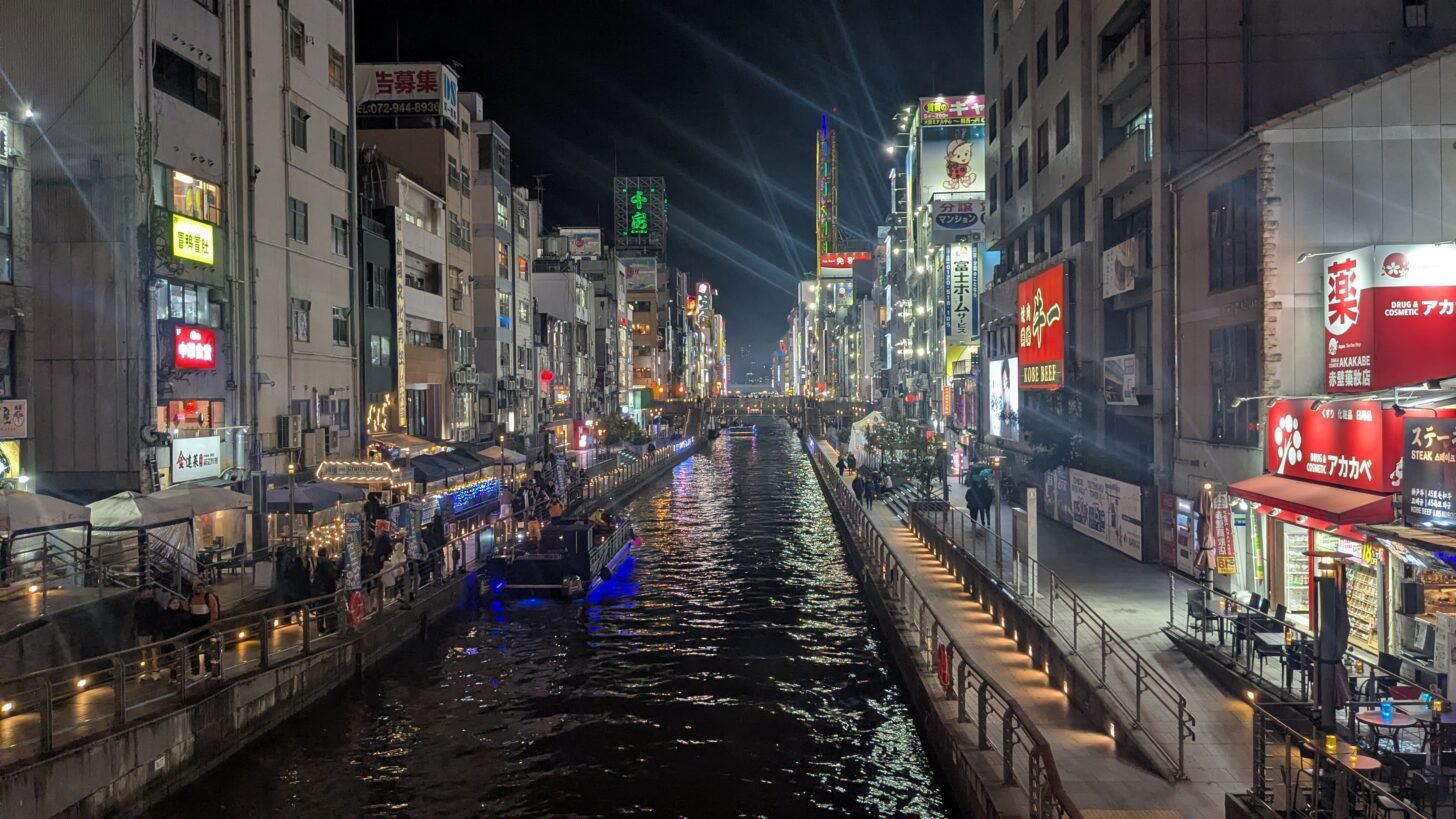
Anyway, when I arrived in Osaka, it was a shock to the system because Osaka is a big, busy, bright, loud city. Osaka kind of has the reputation for being the wild and crazy place in Japan where people are more laid back. There’s more partying, there’s more nightlife. So it was very strange to come from this sleepy mountain resort town to this big brash place.
But I checked into my hotel, I went and got dinner at just like a local little cheap buffet-style eatery, and I started to kind of shift into Osaka mode. So there’s this big street in Osaka called Dōtonbori. It’s like a massive street full of neon lights and, uh, food stalls and shops and nightclubs. And it’s like the place to go in Osaka when you’re a tourist because you can kind of experience that rush of like, oh my God, like the big city.
So I went there and I hated it! It was just so touristy. To be honest, being in China, I kind of got used to being the only foreigner in many places and I guess I kind of liked that feeling, whereas in Dōtonbori I was like, there’s loads of tourists here, these food stalls are all selling food that you could get anywhere in Japan, it’s really busy and crowded, and it’s just a bunch of lights, like it just didn’t appeal to me in the same way.
However, what did appeal to me was going out to bars in Osaka. I had a lovely time going to some bars, but I’m going to be a horrible little tease and only talk about this in a bonus episode. Oh, I know! Oh, Ariel, you’re so awful! Oh, Ariel, how you torture us! But it’s true. Just like with Hangzhou, where I made a separate episode about the nightlife in Hangzhou, I’m going to make a separate bonus episode here about the nightlife I experienced in Osaka, partly because some of the topics are maybe not super appropriate for the main show.
So if you would like to hear all about my bar experiences in Osaka and Fukuoka, because I also went out to some bars in Fukuoka, then you can listen and enjoy all episodes of the podcast ad-free by joining Easy Stories in English Premium at EasyStoriesInEnglish.com/Support. Okay, advert over! Let’s move on.
So I went out to some bars, beep. Mm mm. Insert bonus episode here. I went to bed and then the next day I met up with someone off an app. I used an app, which is a, an app that’s used to make friendships and connections, shall we say? And I met up with someone, I made a new friend, and together we explored the city.
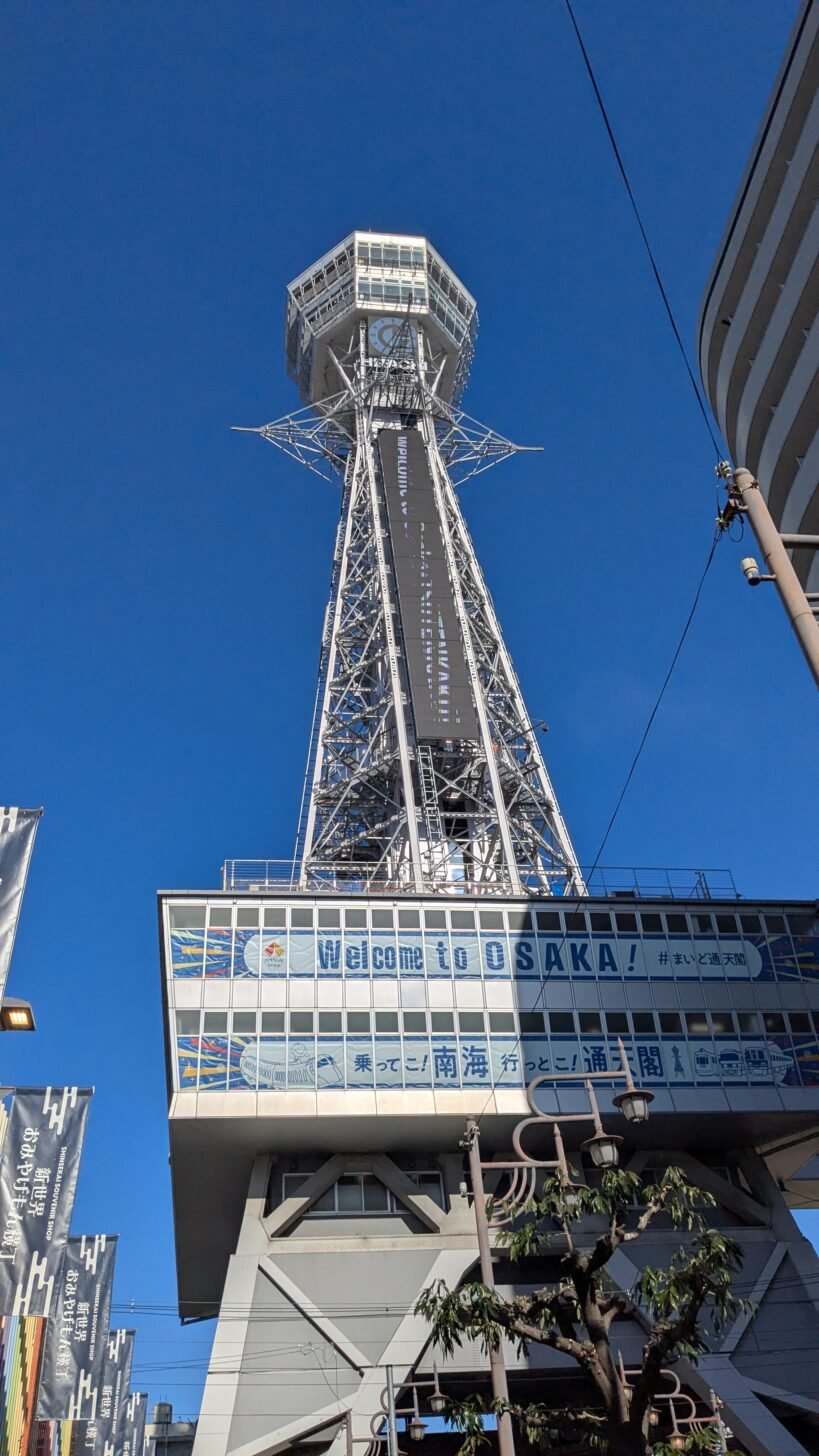
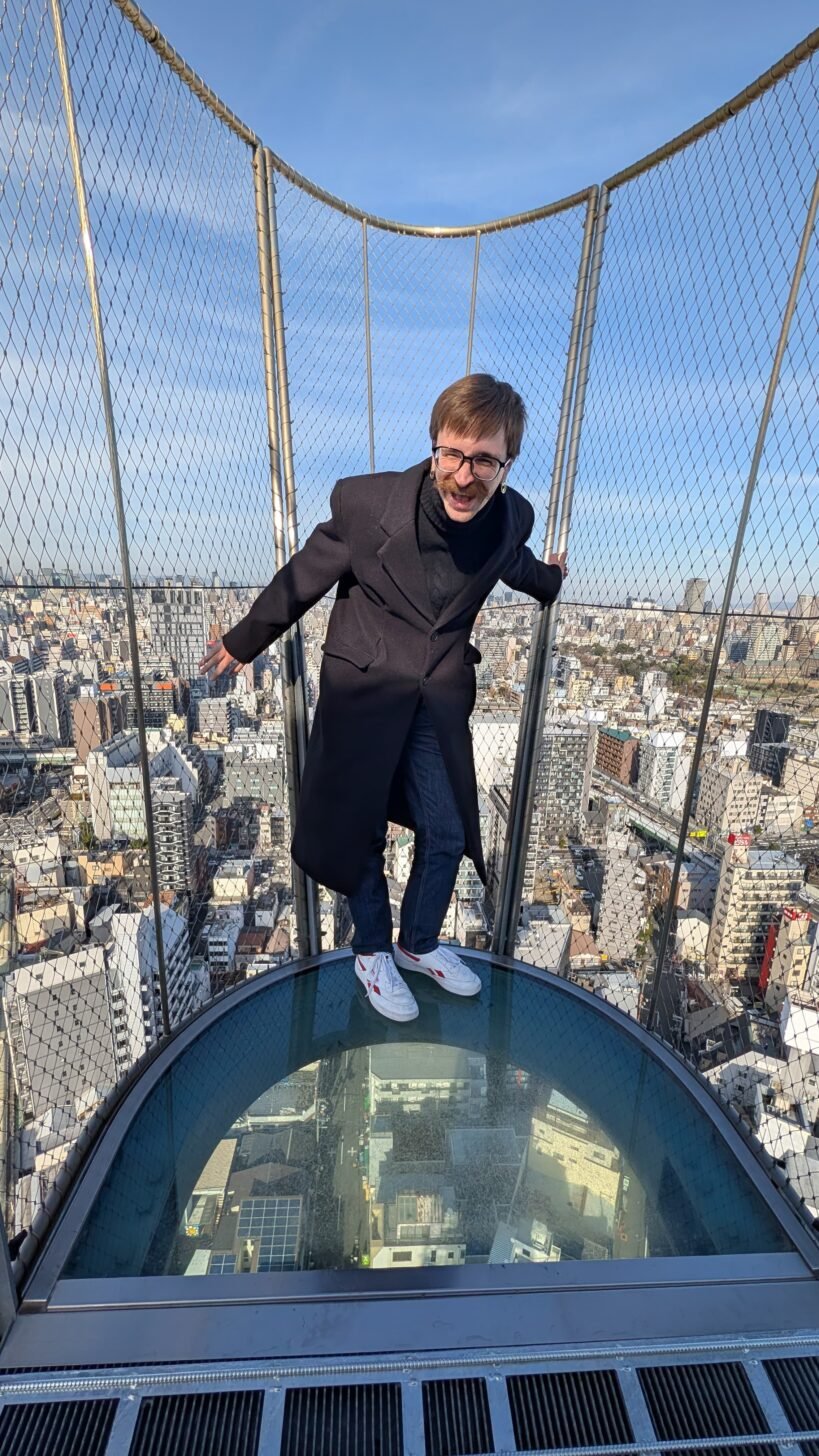
I had not planned a big itinerary for Osaka. Actually, after being alone and having all that resort relaxation time to myself, it was really lovely to just spend the day with another human being. So we walked to Shinsekai, which is a part of Osaka that has all these cool 1920s buildings, all these retro restaurants and advertisements. It’s kind of like a very nostalgic part of the city. And they have this big tower you can go up to get views of the city.
Now this tower was built in the twenties, so like it’s really not that high. I think it’s like 86 or 87 meters. So by modern standards, it’s not very high. But there was something about the presentation, the way they like hyped up this tower, the way it was full of all these like retro adverts. It just felt really cool and really fun. And there was this platform you could stand on to take photos of you kind of with the city as the backdrop. And it was really scary! Like I don’t get very afraid of heights, but standing on this glass platform, I was scared.
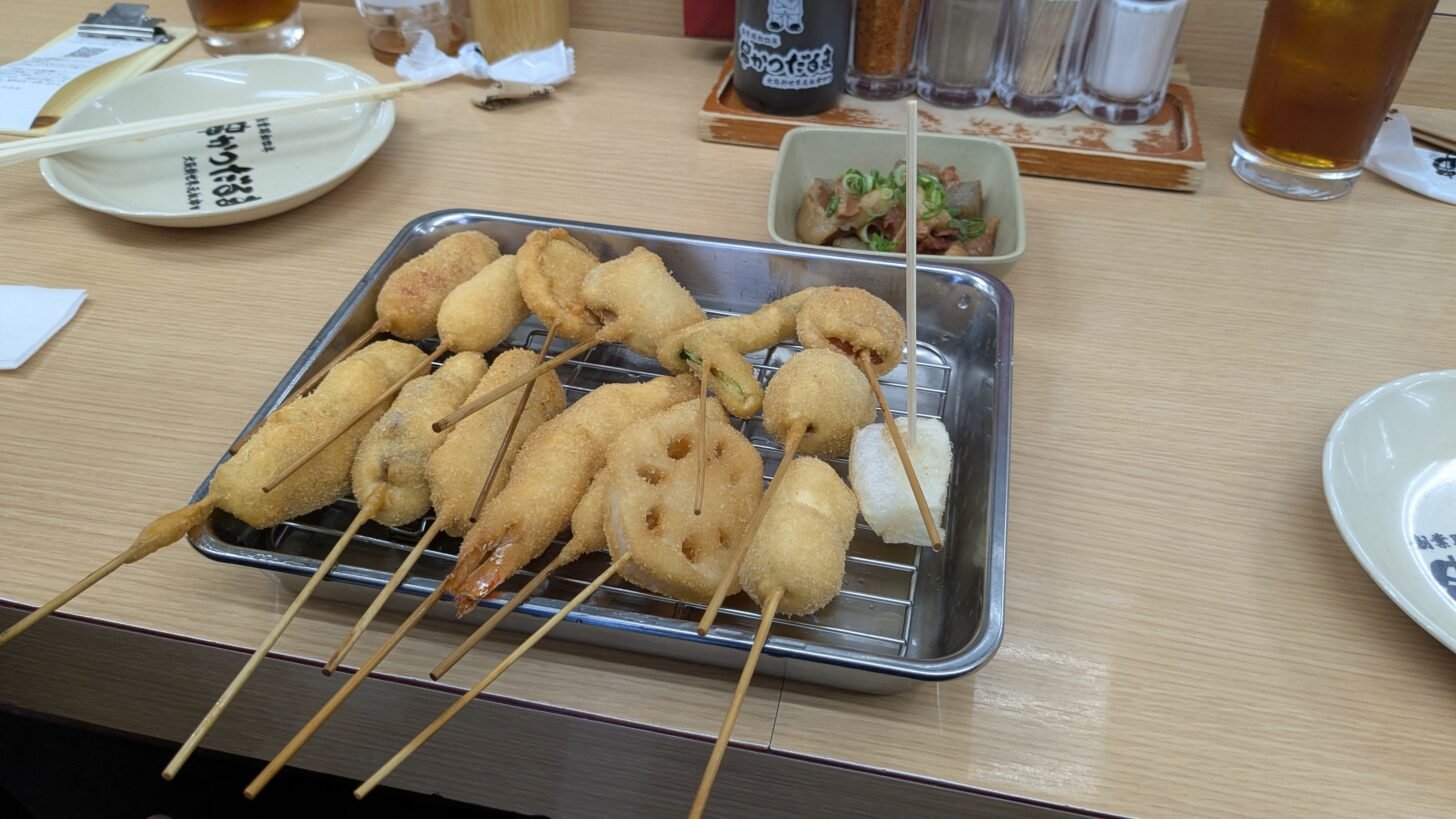
We also had kushikatsu in Shinsekai. Kushikatsu is traditional Osaka food. It’s basically just a bunch of different things deep fried on sticks and it’s very yummy because deep fried food, ah! Pretty much deep fried anything is delicious to be honest. I also went to Krispy Kreme that day. Not exactly traditional Japanese food, but there are no Krispy Kremes in China to my knowledge. So it was nice to have a Krispy Kreme again.
And we went to a, not a traditional Japanese restaurant, but a kind of Japanese diner. There are these kind of fast casual family-style restaurants in Japan that are inspired by American diners that sell this food that’s like a weird, or let’s say intriguing, mixture of Western and Japanese food.
So I had a Hamburg steak, which is kind of like a burger, but without the bun and the salad, with shiso and daikon, um, puree, I guess. So shiso is a Japanese herb that can kind of be used savoury or sweet. It’s used in like smoothies and in a lot of food. And then daikon is like white radish, which I had on top of the shiso. So it was a nice filling cheap meal.
So that was my second day in Osaka, and on the third day I left, but my train was in the afternoon because I was staying with a friend in Fukuoka and my friend was working that day. And that day in Osaka, I was also hungover. Now, I wasn’t hungover from the day before, but from two days before.
I’ve been experiencing this weird thing lately where hangovers skip a day. So I’ll go out drinking, the next day I’ll feel fine, but the day after that I feel awful. And I think it’s something to do with the way that alcohol makes you sleep deprived, like it lowers the quality of your sleep. So the day after I feel fine, and then the day after that I’m tired. It maybe also has something to do with the fact that the day after I drank, I walked like 20,000 steps, like I did so much exercise and that probably exhausted me.
So on the third day, I didn’t want to do anything intense, so I just stored my luggage and wandered around some secondhand bookshops and some other parts of the city. I bought about three or four secondhand books.
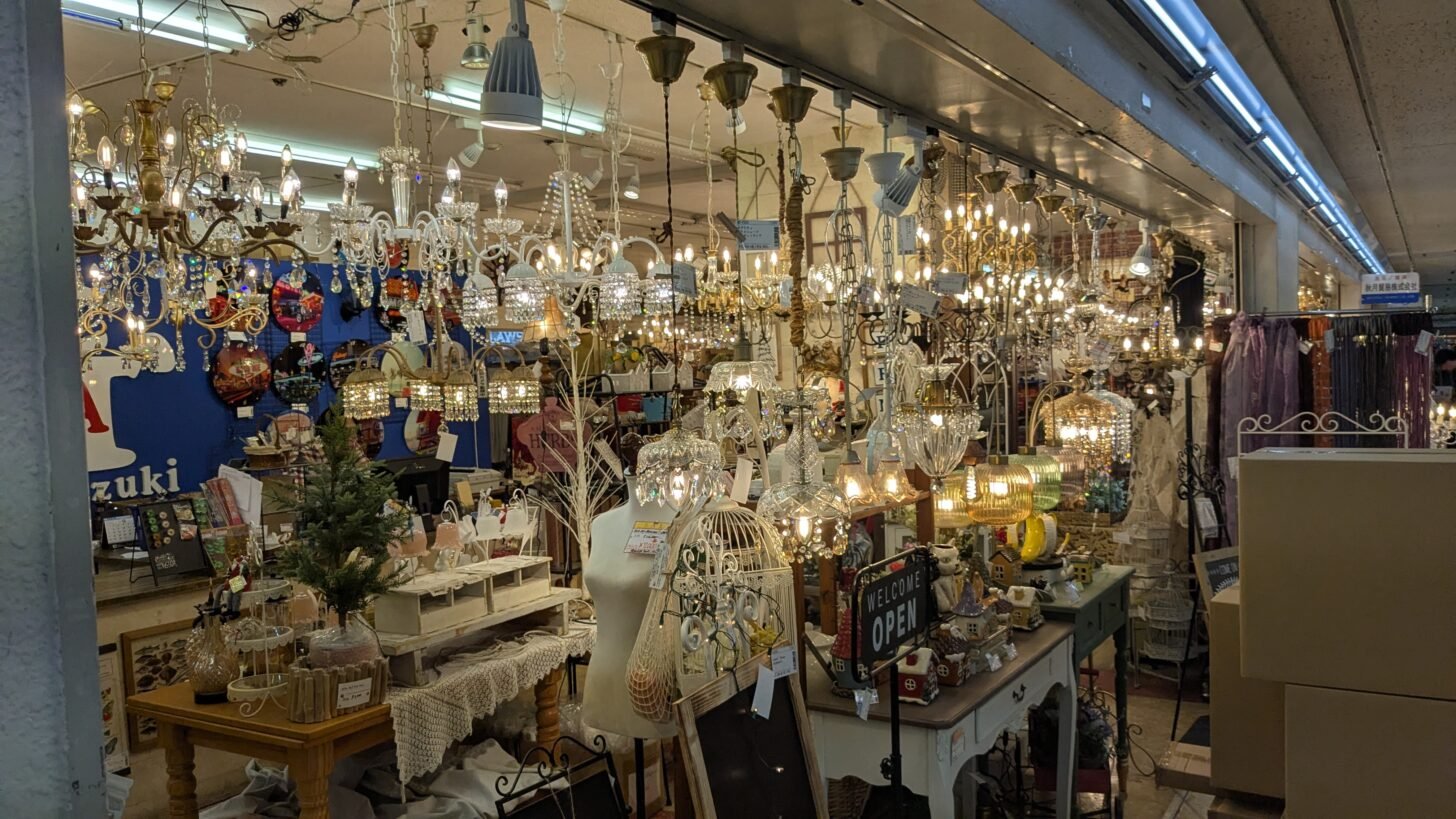
Honestly, Osaka has really lovely shopping arcades, lovely secondhand and vintage shops. There was this gorgeous shop that just sold chandeliers and pendant lamps, and all the lamps were on in the shop, and it just looked so beautiful and kind of felt unintentionally Christmassy. And I just love bookshops in Japan, especially secondhand bookshops. You can get Japanese books so cheaply. Like a lot of the books are like two to 400 yen, which is like, let me calculate. It’s like one to three pounds. It’s very cheap, and I love Japanese literature. I love reading in Japanese, so it was a wonderful opportunity as well.
So, yeah, in general, I just loved Osaka as a city. I really wasn’t expecting to fall in love with it so much. Like many historic Japanese cities, it’s built on a strict grid, like everything is laid out in rows, which in some ways makes it really easy to navigate. In some ways it means you can get lost quite easily. I also felt like, God, if I lived here and I had a bike, I could get around so quickly on a bike, ’cause you can just cycle in a straight line for a really long time. So I definitely want to come back to Osaka. I think that would be nice.
Finally it was onto my last stop, Fukuoka. Now Fukuoka’s station is actually called Hakata. And the reason is, Fukuoka was traditionally two separate towns split by a river, Hakata and Fukuoka. One of them was a samurai town and one of them was a merchant town and they had the castle in the middle where the lord lived. And the lord kind of let them both develop in their own ways. But then when Japan modernised, many cities kind of essentially absorbed towns and villages around them. And this is what happened with Fukuoka. So it’s interesting ’cause in many parts of Fukuoka, the city is still referred to as Hakata.
Anyway, the friend I was visiting is a friend from my hometown. Oh! A bosom buddy back from my teenage years. And I hadn’t seen him in quite a few years because he’s been living and working in Japan. So it was so cool to visit him again, especially in Japan, and to see where he was living, because he’s living in this subsidised accommodation. It’s like maybe a 1970s or a 1980s apartment building with like a traditional tatami room in part of it. So really cool. Much more interesting than staying in a hotel.
It definitely was freezing cold. Um, his building was like, yeah, old and cold are the two words that come to mind, especially when you’re sleeping on the floor on an air mattress in an unheated room. But it was a good time.
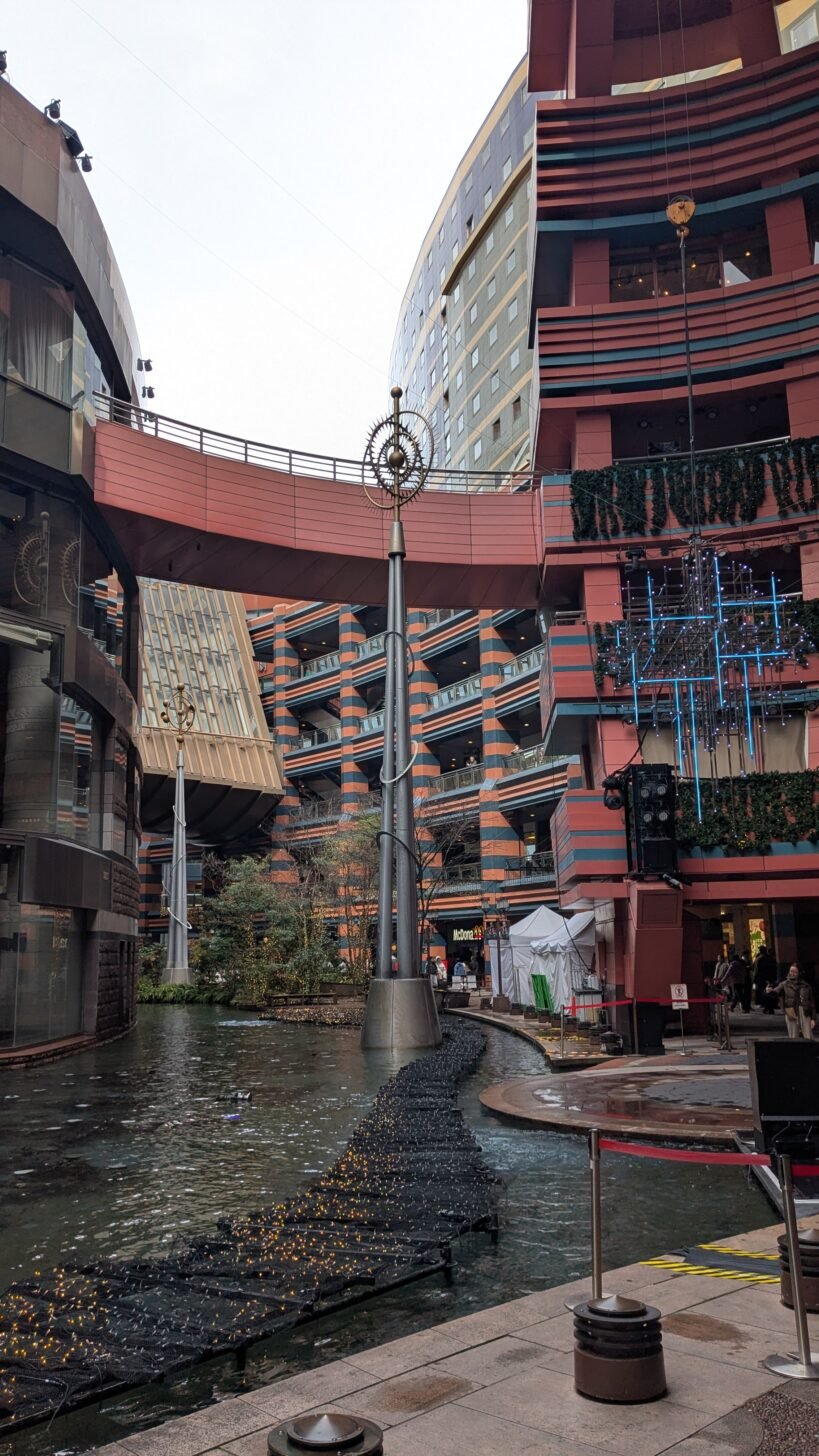
So we did a lot of things in Fukuoka over three days. We went to some arcades, some like video game arcades, and shopping malls.
Actually, we had a very embarrassing experience in the arcade. So there’s this thing in Japan called Purikura, which is short for puriti kurabu, like Pretty Club, which are essentially these photo booths. So you go in with your friends, you take a bunch of pictures, and then afterwards you can edit them, add stickers, add filters. It’s kind of the original Facetune. It’s been around for years. I’m shocked that it’s still so popular because Facetune exists now, but it’s kind of got this cult following among mainly Japanese teenage girls. But, um, it’s fun for all ages!
So me and my friend tried it out. We like put our money into this machine and then we went in and there were like two parts and there was one part for editing the picture, but it was like, oh, I think we have to choose all the filters and stuff first. But it was weird ’cause it had this photo of these two girls on it, but we thought maybe it was just like a sample photo or something, and then we would go in and take the picture.
So we, we were editing these pictures for ages, and then these girls came in and said, uh, excuse me, I think that’s our picture. And we realised we had just edited someone else’s picture. So it was really confusing. Like we had paid for the machine and it had taken our money, but somehow we had ended up going in and editing someone else’s picture. I don’t understand what happened. Either way, it was incredibly embarrassing, like deeply, deeply mortifying. I was bright red as a tomato and we could not find any staff around to assist us. So we never got our money back! Ah!
Another way the arcade kind of scammed us, this was actually a separate arcade, but we played this Mario Kart game, except after we sat down to play, I realised my items button was broken. So I couldn’t use any items in Mario Kart. However, I still came in first place. So sometimes you don’t need items, you just need mad skills.
Another thing we went and did was karaoke. Love me some karaoke, especially in Japan. And this friend of mine, one of the things we originally bonded over as teenagers was Vocaloid.
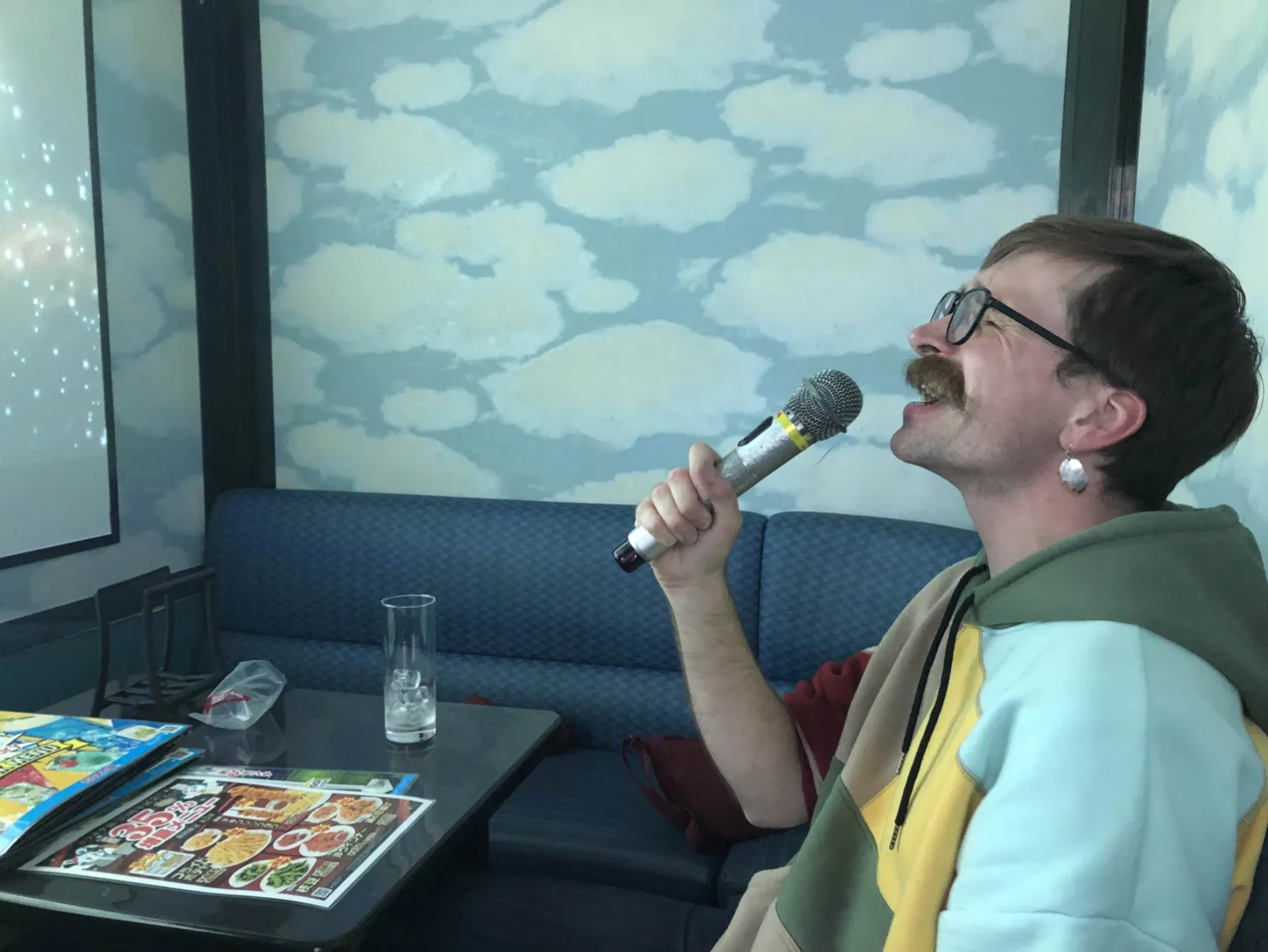
So this is a bit niche. Uh, Vocaloid is this like software. It’s like a vocal synthesiser. So they’ll get people to record a bunch of samples and then you can use it to create music, just like you would use like a keyboard, for example. And there’s this whole community of musicians in Japan who make music using Vocaloid. It has a very specific kind of subcultural style. It actually has innovated a lot, I would say, within Japanese pop and rock music.
So we sang pretty much exclusively Vocaloid karaoke because my friend can’t really sing that with his colleagues because they don’t know the songs. And if you sing those songs with most people in Japan, they’ll be like, wow, you’re a big nerd. And we are big nerds! So it was great to be able to nerd out together.
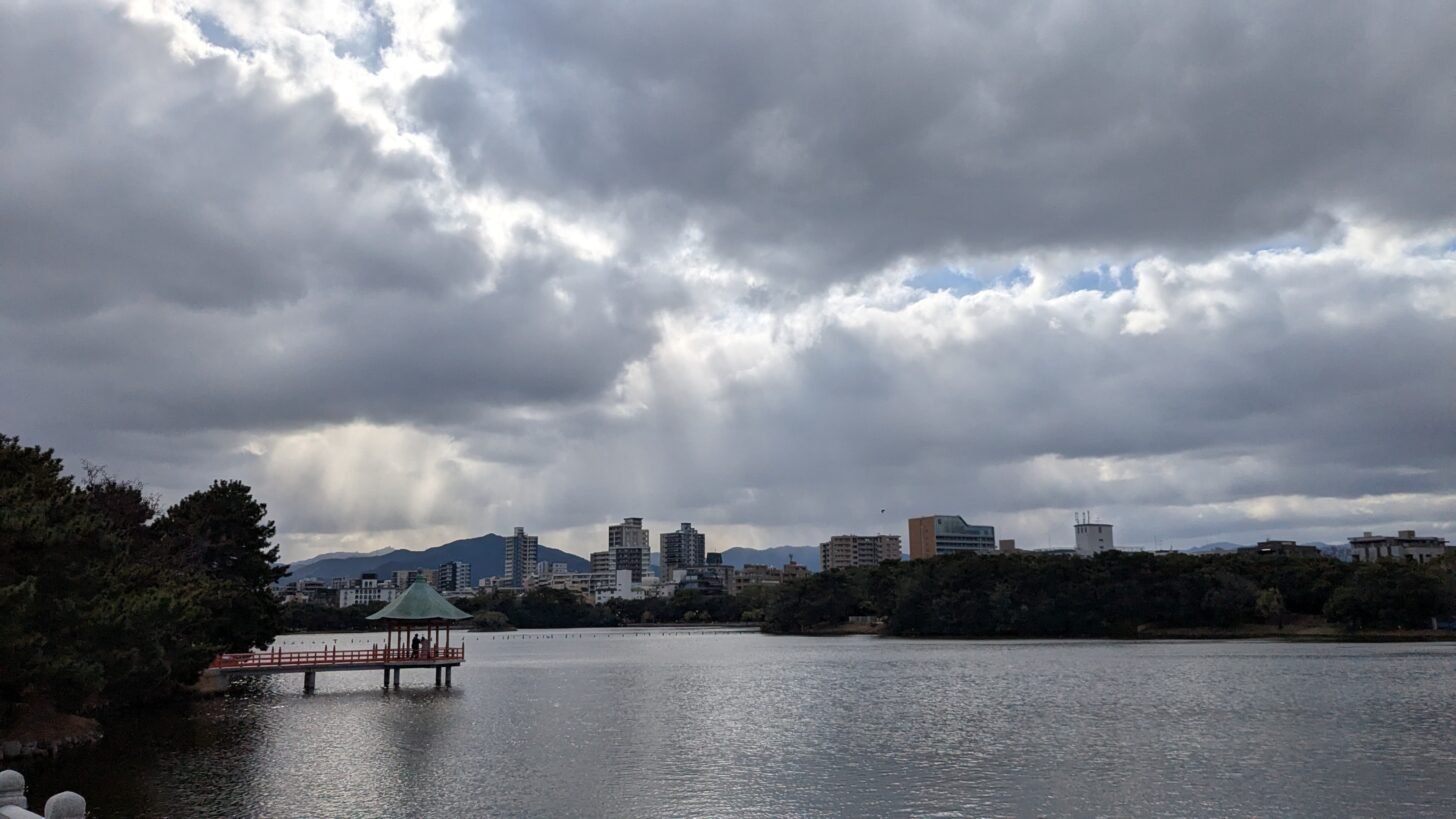
I also explored a bit by myself. I walked around the ruins of Fukuoka Castle. I walked around Ōhori Park, which initially I didn’t think would be so interesting because it’s styled after a traditional Chinese garden, so I thought, oh, it’s just gonna be like a smaller version of West Lake in Hangzhou. But actually it was gorgeous and I could see some birds flying around. I believe they were cranes. There were lovely pine trees. But most importantly, I had lunch in a restaurant in this park that changed my life.
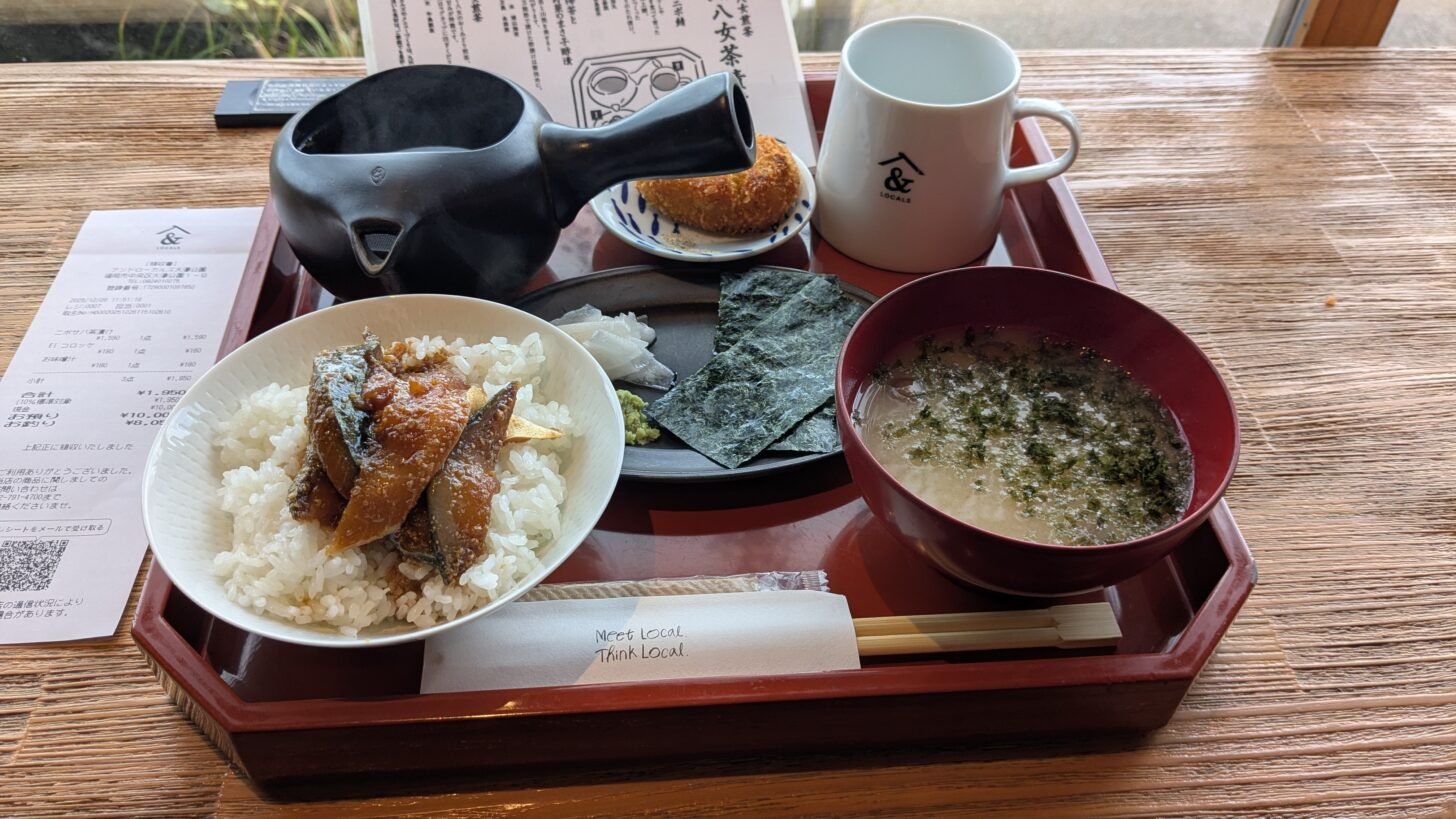
It was a very traditional Japanese meal. I had chazuke. So chazuke is like a Japanese comfort food. It’s just a bowl of rice with green tea poured over it. But this was like high class elevated chazuke. So on top of this rice was this pickled mackerel, and it was pickled with this kind of like bitter orange as well. So it had this really interesting orange flavour. The green tea was very high quality because this place was like a tea house. It also came with some local vegetables and seaweed and some incredibly strong wasabi, like the kind of wasabi where you eat it and you go like, ooh, and you like feel the heat like melting your brain, kind of wasabi. And I never liked wasabi before, but after eating spicy duck necks in China, wasabi seems really quite manageable, I would say.
And I had a korokke, or a croquette in English, although croquettes aren’t that popular in the West, it’s essentially just like a fried ball of usually like mashed potatoes, sometimes some kind of mashed, uh, meat or fish. And this was, oh, it was the best croquette of my life! The outside was so crispy, the inside was so creamy and soft, and oh my God, that croquette, I’m still thinking about that croquette. That croquette was so delicious. Oh! So yeah, that meal changed my life.
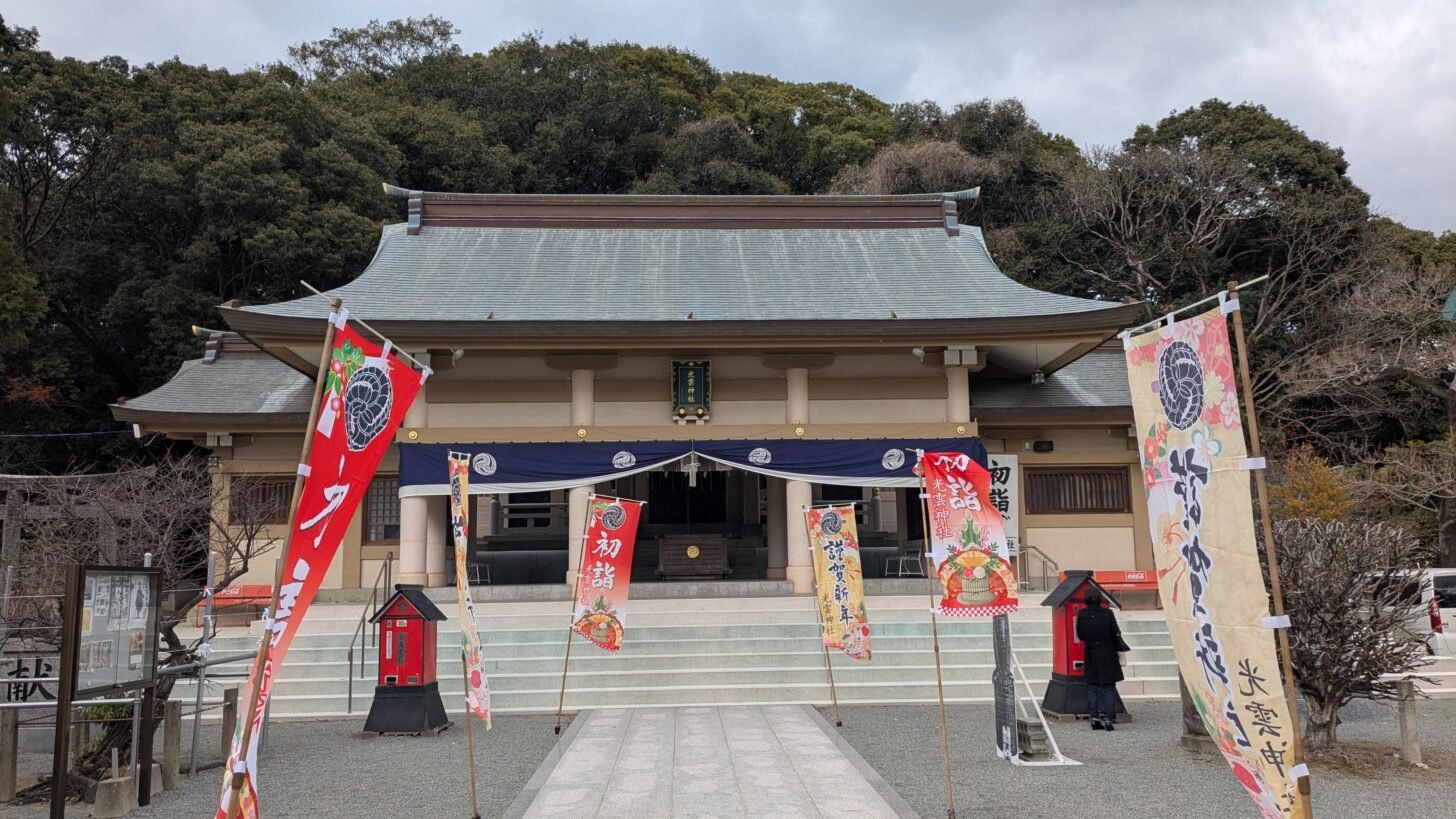
I also visited this really weird shrine in Fukuoka, which was one of the historical shrines in the city, which kind of celebrates this clan that founded and ruled the city, but it was destroyed when it was bombed in World War II, I believe. So they relocated it and rebuilt it in the 1960s. So as a result, it just doesn’t look like an ancient Japanese shrine because it looks quite modern in the building materials. And then because it’s celebrating this clan, it kind of has this weird touristy vibe to it. And there are even like around the corner some like neon signs and a bunch of old, like red shrine gates, it, it just has a very strange vibe. It’s not like any other shrine I’ve been to in Japan. It kind of feels like if Disneyland did a Japanese shrine.
And finally in Fukuoka, as I alluded to earlier, I went out to some bars with my friend. But you’ll just have to listen to the bonus episode to learn about that. EasyStoriesInEnglish.com/Support.
So anyway, this episode is called Christmas in Japan, but I have basically not talked about Christmas at all, right? And as I said, Christmas is not a big thing in Japan. It’s strange because before coming to China, I thought I would miss Christmas more, like I thought I would miss my family more. But the truth is, when you’re not surrounded by all the Christmas lights and Christmas music and people talking about Christmas and eating Christmas food, it’s not that big a deal. Like I had to remind myself on Christmas day to text people and say Merry Christmas and all of that.
Now, there were more Christmas decorations in Japan than China. They were playing like jazzy covers of Christmas songs everywhere. Japan loves jazz, and I love Japan for loving jazz. They play such good jazz in Japan. Ah!
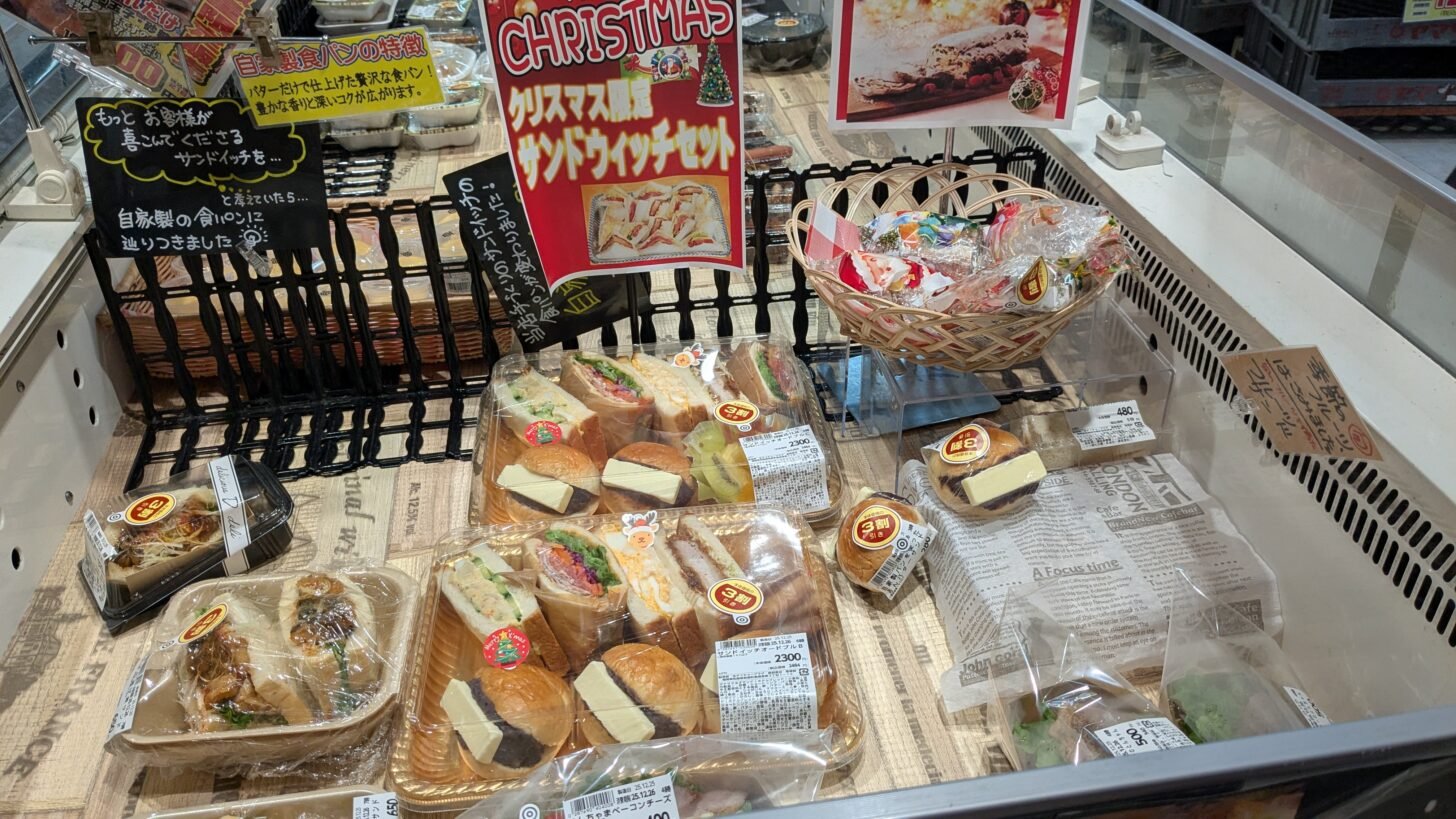
I also saw some really weird Japanese takes on Christmas food, like Christmas sandwiches at the supermarket and some weird Christmas sushi stuff where I was like, this has nothing to do with Christmas. It’s worth noting that in Japan, it’s like a couple’s holiday more than a family holiday. If you’re a man, a single man in Japan at Christmas, you better find a girl to take on a date or you’re a loser, is like kind of the thing. And the most traditional Japanese Christmas food is KFC for some obscure reasons to do with KFC marketing themselves as Christmas food.
I did see a bit of snow! It’s snowed a tiny, tiny amount in Fukuoka, so I can say technically I experienced a white Christmas. Anyway, I had an evening flight. Fukuoka Airport is super central, very easy to get to, very close to my friend’s house. And I had a pretty uneventful journey back to China. I did stay a night in Shanghai on the way back in another hotel that was slightly dodgy, but in a bit of a different way. It was kind of like a guest house. And when I left in the morning, I couldn’t actually find the guy to return my key card to, so I just left it on the table and wrote him a little text message saying I left the card on the table.
But anyway, pretty much as soon as I arrived back in China, I was hit by two very conflicting feelings. One, there was a sense of, oh, I’m home now, but this was the first time I had come home to a country that’s not the UK, right? Because I live in China now, so it’s very strange to come home to a country that’s still foreign to me in many ways.
And then the other feeling was just culture shock. After being in Japan, especially more rural parts of Japan where it’s really quiet and peaceful, the boisterousness of China really slapped me in the face. Life is just a bit louder here, especially when you go to a train station and you’re getting a taxi and everyone is honking their horns and sometimes people are spitting in public and like, oh, it’s just, it’s a lot louder and more intense.
Also, to be honest, I think Japanese culture is just a lot closer to British culture. We’re both island nations. We’re kind of doing our own things in some kinds of ways. We like being polite. We place a lot of importance on that. So it still feels, um, I don’t know if ‘incongruous’ is the word, but certainly there are still many aspects of Chinese culture that I am adapting to.
But anyway, it was an absolutely fantastic holiday. This was the first time I had been to Japan since 2013, and obviously since I recently passed the highest level of the Japanese Language Proficiency Test, I was quite interested in coming, and I’m really glad I did, and I’m already planning future holidays to Japan.
Obviously I want to travel around in China as well, but I should take advantage of Japan being so close. And it’s pretty affordable. I did spend more money than I intended to on this holiday, but it’s pretty impossible to avoid spending money on a holiday because like you have to eat out every day. And honestly, it was worth it. Like everything I spent money on was absolutely worth it.
I actually got quite emotional at several points during this holiday where I was just kind of overwhelmed by this feeling of love and appreciation for this culture, which I feel a deep affinity for. And it was also nature, you know, beautiful nature. It also probably helped that I was relaxing and on holiday.
I would love to live in Japan in the future. I think moving to Japan would be a lovely thing for me, and that’s all I’m going to say on that for now. Wink, wink. Um, let’s just say thoughts are in motion. Plans are awhir. Awhir? Is that a word? Plans are whirring in my head. Things are spinning around. Woo!
Okay, I think this episode has gone on long enough. One final reminder, if you would like the super special bonus episode where I talk about all of my ooh, intoxicating and maybe a bit naughty experiences in the bars of Osaka and Fukuoka then you can join Easy Stories in English Premium at EasyStoriesInEnglish.com/Support, where you can also get episodes like this with no advertisements, no commercials. Hmm!
Thank you for listening to this episode of Easy Stories in English. It’s been a wonderful 2025 and I can’t wait to absolutely smash 2026. Look forward to more exciting, vibrant, and lively episodes from me, Ariel Goodbody, the host of this show, and I hope you had a wonderful 2025 as well. And yep. I know I haven’t told you my New Year’s resolutions, but I would love to hear yours if you’re not afraid of wasting your energy like I am, so do leave a comment wherever you are, be it on Spotify, YouTube, or on EasyStoriesInEnglish.com, and let me know what your resolutions are and how your 2025 was.
Thank you again and goodbye! Or, as they say in Japanese, mata ne!
Leave a Reply