Hello my Lovely Learners, and welcome to Easy Stories in English, the podcast that will take your English from OK to Good, and from Good to Great. I am Ariel Goodbody, your host for this show. Today’s pre-intermediate story is called Herding Mountains to Make a Forest. As always, the transcript and PDF are available at EasyStoriesInEnglish.com, and you can find the link in the description.
So today’s story comes from the Sani people in China. So the Sani are a subset, they are a smaller part of the Yi – Y-I – YI ethnic minority. There are 55 officially recognised ethnic minorities in China. So the majority of Chinese citizens are Han, but you also have Dai, He [sorry, this one doesn’t actually exist], Jino, some you might have heard of like Kazakh, Uzbek, Korean and so on. And this story comes from the Sani people who come from Yunnan in Western China.

So before I tell the story, I want to give a bit of the background about how I found this story because it was kind of a full circle moment for me.
So a full circle moment is when you have an experience that kind of finishes a story, it ties everything together. So I found this story in Stone Forest, or in Chinese Shilin, which is a tourist attraction in Yunnan. It is a, um, well it’s a forest made of stone! It’s an area of karst mountain where basically certain geological conditions caused the rocks to make these very distinct, kind of sharp, um, tree-like shapes, and it’s very beautiful and you can go and visit it.
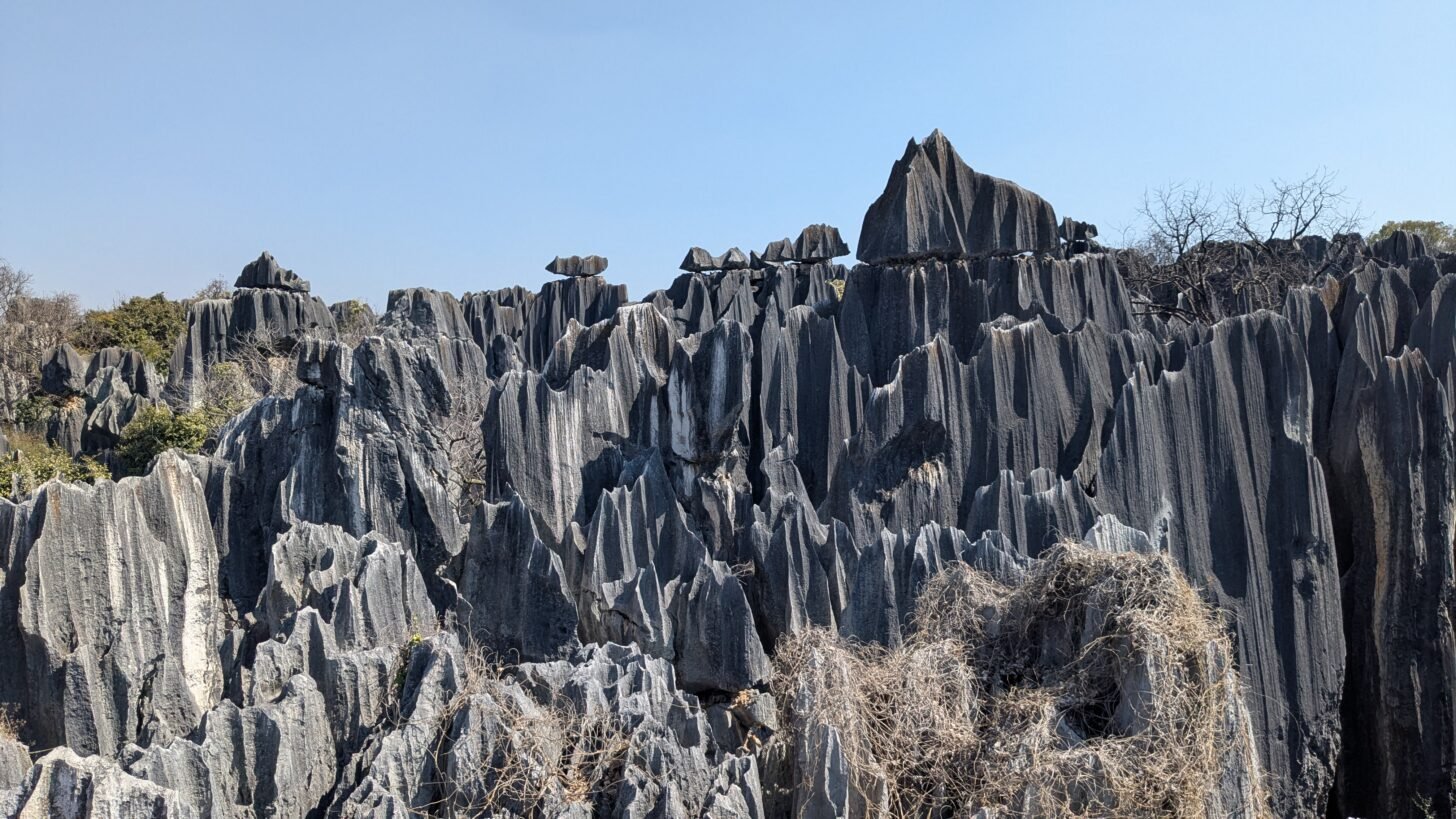
So why was going to Stone Forest a full circle moment for me? Well, I started studying Chinese in 2010. Ooh, that’s a long time ago! 16 years. When I first went to university, I went to Oxford to study Chinese, and there were various aspects of the course I didn’t like. I didn’t like how old fashioned it was. I didn’t like that it focused so heavily on like classical Chinese and Chinese history, and then the modern Chinese was taught, in my opinion, very poorly. Like it was the most kind of traditional, boring grammar exercises, translation, you know, using an outdated textbook where everyone still called each other comrade. It was just a very uninspired and honestly ineffective way of teaching a language.

So after studying there for a year, I decided to drop out. I decided to leave Oxford University to go and study linguistics. I did consider changing courses at Oxford, but um, they only offer linguistics with a language and I wasn’t sure that I wanted to do that. I kind of wanted to just do linguistics by itself, so I took a year out to reapply and I ended up going to Cambridge to study linguistics. So I did okay because in the end I can say that I studied at both Oxford and Cambridge.
But anyway, this experience left me with some complicated feelings about Chinese because I pretty much stopped studying Chinese after I dropped out. And later on I maybe had some regrets. I thought there was something that was left unresolved. ’Cause it wasn’t like I had no interest in studying Chinese or Chinese culture, but it just wasn’t the right time and style and place for me to be doing it.
And also to be honest, I at that point really needed to just make that decision for myself because I didn’t really choose what I wanted to do at university, or rather, I was very undecided, and I slightly felt like I was just pushed into making that decision. I was going to do Japanese at university, but all of the university courses were ab inicio, which means starting from scratch, starting from zero, and I already spoke really good Japanese, so it seemed really stupid to study a language from scratch when I already spoke it, right?
So people said, oh, you should just do Chinese. You already speak Japanese. You’re good at languages, you should do Chinese. So I kind of just did what people told me. And then later on I was like, no, I wanna make this decision for myself! Which is why I dropped out and ended up doing linguistics.
So anyway, I was left with these complicated feelings about Chinese. I didn’t really study it or I studied it like a tiny bit after that. But then, in 2023, I went to the Agen Workshop, which is a language teaching conference in the south of France. It’s a conference for people who teach languages using storytelling such as me, and at this conference they do language labs. So every morning you go and observe classes from another teacher in a variety of languages.

So I went to a Chinese language lab where Diane Neubauer was teaching. So Diane Neubauer is a fantastic American teacher of Chinese, and I observed her Chinese language lab. And it was just a lovely experience because I got to learn Chinese in a good way, like taught really well, taught in a very warm, approachable, patient and fun way.
And the whole course that Diane did was based around the Stone Forest and the Sani people because she had lived in Yunnan, China. So it was a really different approach because obviously most information about China just focuses on the Han people who are the ethnic majority in the country, and we don’t really hear much about the ethnic minorities. So it was a lovely different way to learn about Chinese culture. It was lovely to learn about Stone Forest, and it just really left me with this feeling of, oh, one day I would like to go to Yunnan. And guess what happened? That day came!
But I’m getting a bit ahead of myself. After I did that course, it revived my interest in Chinese. It made me interested in learning Chinese again. I did an online course with Diane Neubauer. I started doing self-study through watching YouTube videos, listening to podcasts, reading, and then finally, last year I moved to China, so that certainly, um, made my Chinese study a bit more intense!
But yeah, as I said, I knew I wanted to go to Yunnan at some point and then a month ago I was planning on going to Cambodia with my parents, and the best flight option was to fly to Kunming, which is in Yunnan, stay a day there, and then fly to Siem Reap in Cambodia. So it was perfect because I had a day in Kunming and I could go to the Stone Forest, which is about an hour-and-a-half by taxi from the city.
So it was actually the ideal situation. Obviously I would love to visit Kunming again and spend more time there and visit more of Yunnan. It is the area with the highest diversity of mushrooms in the world, and I find that very exciting as someone who loves food and mushrooms.
Stone Forest was a lot busier than I expected. Tourism is very boisterous in China and it’s very developed. So, you know, I think I had this image that it would be like these nature sites in the UK where there might be like a car park and maybe some food stores and some toilets, but that’s it. But no, it was like, oh, there’s a big tourist information center. You get a bus in, then there’s a bunch of stalls and loads of food places. And then when you come back, there’s a whole like massive corridor of like restaurants and shops. And then the bus drives you back to another place where there are like all of these shops and buildings and…
I found it a bit over touristy. It was also surprisingly busy. I went on Lunar New Year’s Day, so the first day of the Year of the Horse, and I think I thought it would be less busy ’cause I guess I thought people would be spending time with their family, but I guess people, local people, were looking for something to do, so there were a lot of people there.
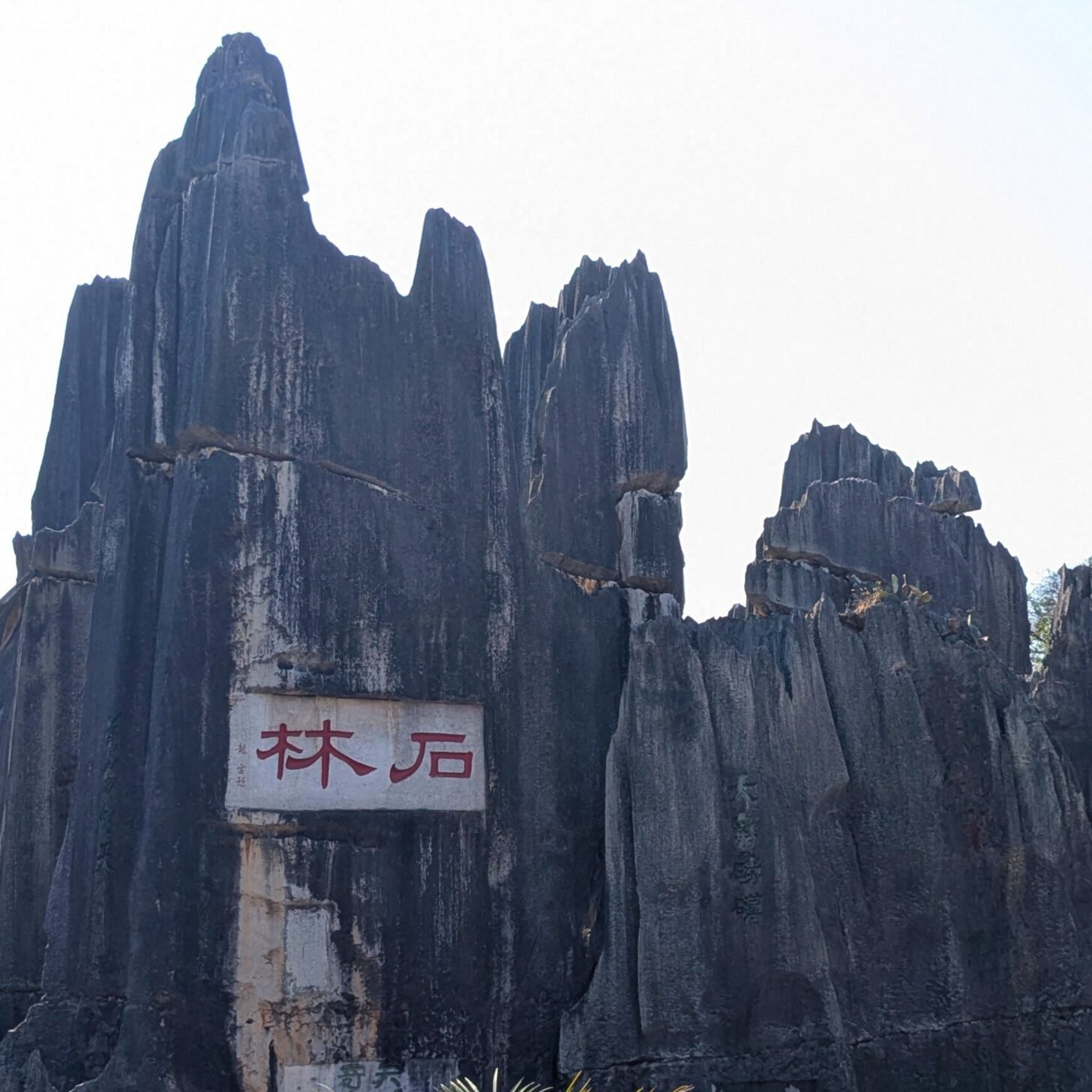
Still, it was very beautiful. It was interesting to see that all the local tour guides – there were a lot of local Sani tour guides and they all wear their traditional clothes as they guide people around. While at the Stone Forest, I learned that the name actually comes from a Chinese governor. In the 1930s, the Chinese provincial governor of Yunnan was travelling the province and he came to Stone Forest and thought it was beautiful. So he named it and he asked them to carve the characters for Stone Forest into one of the rocks, which is kind of funny. It’s, it’s a very colonial, um, kind of way of doing things. But, uh, yeah, so originally I think it was a kind of sacred or important site for the Sani people, but it didn’t have this kind of named status, shall we say?
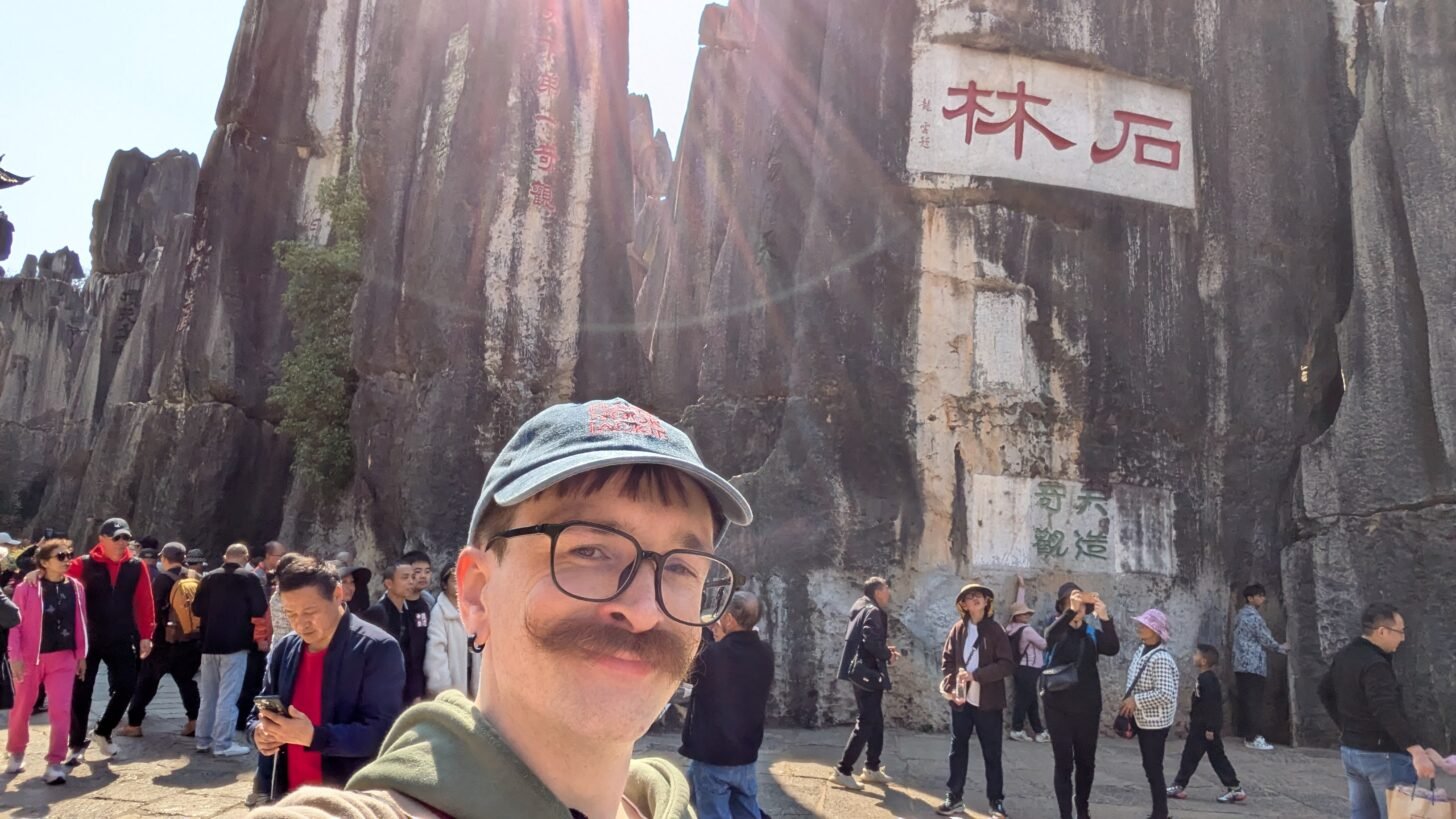
While wandering the Stone Forest I also discovered the origin story. So the Sani people have a lovely myth about how this forest came to be, and that’s exactly the story we’re doing today.
I do recommend you visit the Stone Forest if you happen to go to Yunnan. I think it’s a cool place if you like cool rock formations, and who doesn’t love a cool rock formation? It’s definitely worth visiting, but to try to avoid the peak season. Fortunately, one of the best things about Yunnan is it basically has good weather all year round. Kunming is known as the City of Eternal Spring. It ranges from 20 to 25 degrees all year. So you can go at basically any time.
So although the Stone Forest wasn’t this beautiful, magical moment that I had maybe hoped it would be, it did feel like a full circle moment to have the reason I got back into studying Chinese with Diane Neubauer. To have this experience it kind of brought it all together. Like, look at me! I live in China now! Ha! And as my friend said, who I studied with way back in Oxford in the day, me coming to China is a bit like me doing the year abroad that I would’ve done if I had stayed studying that degree.
And I don’t know, not to get too emotional about it, I really did have a lot of shame based around China, learning Chinese, dropping out of university. It was something I carried around for a long time. So coming to China was a really difficult decision. Like it really took me a lot of courage to say, no, I am gonna do this even though I dropped out before, when, of course, actually that doesn’t matter. You know, whether I studied Chinese at university before or didn’t, whether I had dropped out or finished, this decision is a completely separate thing that I’m enjoying very, very much! So, yes.
OK, I’ll just explain some words in today’s story.
A herd is a group of animals: a herd of sheep, a herd of pigs, a herd of cows and so on. When you herd animals, you move them together in a group. For example, shepherds herd sheep. Shepherds use a special dog called a German shepherd to help herd the sheep. They herd the sheep and move them around different fields so they can eat all the different grass.
A bucket is a round thing that you use to carry water. Buckets are about the size of rubbish bins. You fill the bucket up with water, or maybe sand, or milk or something like that, and then you pick up the handle of the bucket and carry it. We also use buckets when we go to the beach to build a sandcastle.
A spirit is like a ghost. In some cultures, they believe that spirits live inside us. With magic, our spirits can leave our bodies and fly around. In some cultures people believe that when you die, your spirit leaves your body. And in some cultures spirits live in rocks, trees, rivers and so on.
An order is when you tell someone to do something. For example, your boss might order you to write a report. Orders can be written or spoken. A written order is usually quite formal.
A whip, W-H-I-P, is a long object that you use to hit animals with from far away. You swing a whip around in the air and then strike the thing you want to hit with it. Whips make a sound like WHAPISH! Indiana Jones uses a whip to swing across big gaps and to get objects from far away, but that’s not normally the way whips are used.
When you’re holding a whip but not using it, it’s usually rolled up, but when you want to use the whip, you unfurl it – spread it out. You have to unfurl the whip so you can swing it in the air.
Dams are walls that are built on top of large rivers. Dams stop a river’s flow and collect the water, so that it can be used to provide water for an area. Beavers build dams out of wood to make an area of water where they are protected from animals that want to eat them, and they can store their food there over winter.
A rooster is a male chicken. Roosters are larger and more colourful than hens, female chickens. Roosters also crow, call out loudly, in the morning. Cock-a-doodle-do!
Freeze, and the past tense is froze, is what happens when something goes very cold. When water gets very cold, it freezes. If a river or a lake freezes, you can walk on it. If the weather is very cold outside, you can say, ‘It’s freezing!’ If you are moving and then you suddenly stop moving, you freeze. For example, when the police want to catch someone, they say, ‘Freeze! It’s the police!’
OK, so listen and enjoy!
Herding Mountains to Make a Forest
Once, a long time ago, the Sani people were very poor. When it rained, they caught the rain in buckets and drank the water. But when it didn’t rain, their buckets went empty, and the people went thirsty. Sometimes, they were so thirsty that they could not move.
Among the Sani was a hero, a man named Jinfenroga. Jinfenroga was not only strong, but also clever. He had never lost a fight, and he had never lost an argument, either. One day, after a long period of hot, dry weather, Jinfenroga looked at the empty buckets and said, ‘My people! We cannot go on waiting for the rain like this. If the water will not come to us, then I will bring it to us.’
So Jinfenroga waited for night, and then set off. First, he went to the caves, where strange spirits lived. He went quietly inside, because the spirits were sleeping, and stole two valuable objects: the Mountain Moving Order and the Mountain Herding Whip. The spirits used these to hide from the Sani. When the Sani came near, the spirits would move the mountains so that the Sani could not see them, and when the Sani left, the spirits would return the mountains to their usual places.
But Jinfenroga did not plan on using the magic objects for that. Instead, he walked to a place with many long, tall mountains. He held up the Mountain Moving Order and began to read it. Jinfenroga was one of the few in the Sani who knew how to read, and he knew how powerful reading could be.
‘Tick-a-tack tack, arrack, arrack! Montini dontini stilli willi! Hillzo willzo moovoo yoovoo! Wackily, wackily, wack!’
As he read the magic words, the mountains began to move. At first, they only shook slightly, like a child waking from a deep sleep. But slowly, they began to jump and run, as if they had grown feet and were in a hurry to get somewhere.
But before the mountains could run away, Jinfenroga unfurled the Mountain Herding Whip and swung it with all his strength. WHASH! The whip struck the ground and all the mountains screamed in fear. Or they would have, if mountains could talk. They all moved into one group, some so scared they were shaking, and waited to hear what Jinfenroga had to say.
‘Mountains, my people have been thirsty for too long! I am going to build a dam, and you are going to help me. You will come with me to the river and lie down, so that I can dam the water and my people will always have something to drink. Understood?’
If the mountains had heads, they would have been nodding them furiously. So Jinfenroga set off with the mountains.
They walked through the hills, up and down, straight and around. When a mountain was too slow. Jinfenroga opened the Mountain Moving Order and said some magic words (‘Hurry uppus!’), and when a mountain moved away from the group, he unfurled the Mountain Herding Whip and swung at them. Soon, all the mountains were moving quickly and orderly. None of the spirits seemed to be following them, either.
But as they passed through a certain field, the sun was starting to rise. In this field lived a magic rooster. Every morning, the rooster crowed to wake up the spirits. This morning was no different. The magic rooster held his head high and crowed loudly.
The mountains, hearing this, were so surprised that they froze in place. Jinfenroga tried reading from the Mountain Moving Order (‘Lazy, lazy, lackadaisy!’), and he unfurled and swung the Mountain Herding Whip a dozen times, but it was no use. The mountains were well and truly frozen.
And that is why today, in a certain area of Yunnan province, you will not find a dam, but a stone forest. In the morning, you will hear the crow of a rooster, loud and impossible to miss, and if you listen closely, you might even hear Jinfenroga shouting at the stones and swinging his whip.
THE END
Well, I hope you enjoyed today’s story. You know me, I love a good origin story. I love a myth that tells us why something is the way it is, why something exists. So when I saw this story, I was like, yes, give me that! I’m going to put that on the podcast. Ah!
And in other news, I am back. The last few episodes I recorded batched. I recorded them back to back. So like I recorded them a really long time ago because I was on holiday, but I’m back from holiday now. I went to Cambodia with my parents. It was really great. I’ve started at work again. It’s semester two. I’ve been doing lots of exercise.
Everything’s going very well, but you’ll hear lots more about that next week when I do a conversational episode! Blah, blah, blah, blah, blah, blah, blah, blah, blah, blah, blah, blah, blah. I know that’s what you all love to hear. You love to hear me just talk and talk and talk.
Anyway, thank you for listening to today’s episode. Have a wonderful day and see you soon! Bye.


Leave a Reply